
Toxonevra
Macquart, 1835
flutter flies
Species Guides
3- Toxonevra jucunda
- Toxonevra muliebris(flutter fly)
- Toxonevra superba(Antlered Flutter Fly)
Toxonevra is a of small flies in the Pallopteridae, commonly known as . The genus contains approximately eight described distributed across Europe and North America. Members are characterized by distinctive wing patterns and male courtship involving wing vibration. One species, T. muliebris, has been sequenced as part of the Darwin Tree of Life Project.
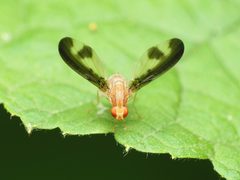
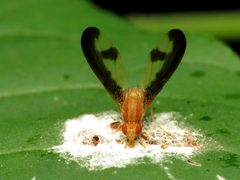
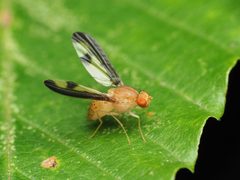
Pronunciation
How to pronounce Toxonevra: /tɒkˈsoʊnɛvrə/
These audio files are automatically generated. While they are not always 100% accurate, they are a good starting point.
Identification
Males can be recognized by their characteristic wing-extending and vibrating , which gives the its . T. muliebris specifically shows a broad brown band that loops around the wing and a brown with two dark dorsolateral stripes. -level identification requires examination of morphological details not consistently documented across the .
Images
Habitat
Larvae occur under bark of conifers and birch; also recorded from elder. frequently found indoors on windows.
Distribution
Widely distributed in western and northern Europe (Spain to Germany, Great Britain, Ireland, Denmark; absent from Fennoscandia), with scattered records from Montenegro, Greece, and Turkey. Also recorded from western Canada (Victoria, BC). In Britain, common in the south, less common in northern England, scarce in Scotland.
Seasonality
active from June to October (based on T. muliebris records).
Diet
Likely mostly saprophagous. may feed on detritus from carpet beetles (Coleoptera, Dermestidae) or the larvae themselves.
Host Associations
- carpet beetles (Coleoptera, Dermestidae) - food source may feed on detritus or larvae
- detritus from carpet beetles - food sourceobserved in indoor settings
Life Cycle
Larvae occur under bark of conifers and birch; also recorded from elder. active from June to October.
Behavior
Males extend their wings and vibrate them during courtship, giving the the "".
Human Relevance
frequently found indoors on windows, where they may be associated with carpet beetle . The of T. muliebris has been sequenced as part of the Darwin Tree of Life Project, yielding a 491.40 Mb genome with 21,433 protein-coding genes.
Similar Taxa
- other Pallopteridae genera share the characteristic male wing-vibration ; Toxonevra distinguished by specific wing patterning in described
- small acalyptrate Dipterasimilar size and habitus; Toxonevra distinguished by looping wing band pattern and thoracic stripes where documented