
Toxonevra muliebris
(Harris, 1780)
flutter fly
Toxonevra muliebris is a small pallopterid fly native to Europe with introduced in western North America. are recognized by their distinctive wing pattern featuring broad brown bands. Males exhibit characteristic wing-fluttering that gives the its . The is associated with tree bark and has been increasingly observed indoors, particularly in North American residences.
Pronunciation
How to pronounce Toxonevra muliebris: /tɒkˈsoʊ.nɛv.rə mjuˈliː.ə.brɪs/
These audio files are automatically generated. While they are not always 100% accurate, they are a good starting point.
Identification
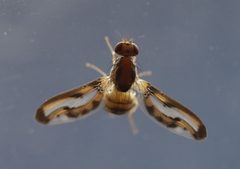
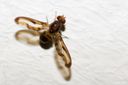
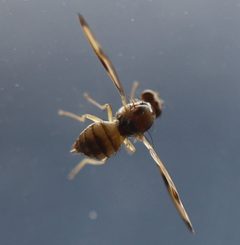
The wing pattern is diagnostic: two broad brown stripes from wing apex to shoulder, one along the sector edge and one through the middle, creating a distinctive banded appearance. This separates it from other Pallopteridae and similar small flies. The pale brown body coloration and small size (approximately 4 mm) are additional supporting characters. Males may be observed performing wing-fluttering .
Images
Appearance
Small fly measuring approximately 4 mm (two lines). , , , and legs pale brown. Wings clear with two broad brown stripes running from apex to shoulder: one along the sector edge, the other through the middle, forming a distinctive looping band pattern.
Habitat
Larvae occur under bark of conifers, birch, and elder. frequently found on windows and indoors, particularly in residential structures in North America.
Distribution
Native to western and northern Europe including Spain, Italy, Austria, France, Belgium, Great Britain, Ireland, and Denmark; scattered records from Montenegro, Greece, and Turkey. Absent from Fennoscandia. Introduced to western North America with confirmed records from Victoria, British Columbia. In Britain, widely distributed in the south, less common in northern England, scarce in Scotland.
Seasonality
active June to October.
Diet
Larvae saprophagous under tree bark. have been observed feeding on detritus from carpet beetles (Dermestidae) or possibly the larvae themselves.
Host Associations
- Dermestidae - feeding on detritus or larvaecarpet beetles; basis for indoor occurrence in North America
Life Cycle
Larvae develop under tree bark. and activity occurs June through October. Detailed pupal and stages not documented in available sources.
Behavior
Males extend and vibrate their wings, producing the fluttering characteristic of the . frequently encountered on windows. Not readily frightened when disturbed.
Ecological Role
Contributes to saprophagous decomposition under tree bark. Possible or associate of carpet beetles in indoor environments.
Human Relevance
Increasingly observed in North American residential houses, possibly due to association with carpet beetle larvae, a common household pest. sequenced as part of the Darwin Tree of Life Project.
Similar Taxa
- Other PallopteridaeLack the distinctive two-banded wing pattern of T. muliebris; wing markings typically less bold or differently configured
- Other small Diptera on windowsT. muliebris distinguished by specific wing pattern and pale brown body coloration
More Details
Genome
sequenced as part of the Darwin Tree of Life Project; assembly size 491.40 Mb with 21,433 protein-coding genes.
Taxonomic history
Originally described as Musca muliebris by Moses Harris in 1780. Subsequently transferred to Palloptera, then to Toxonevra. The alternate spelling Toxoneura muliebris is regarded as a misspelling.