
Tabanus punctifer
Osten Sacken, 1876
western horse fly, western black horse fly
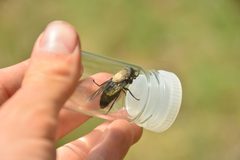
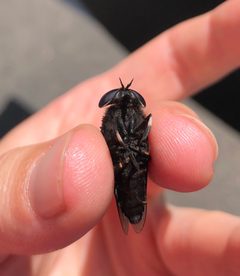
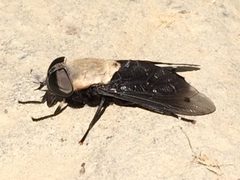
Tabanus punctifer, commonly known as the western or western black horse fly, is a large biting fly in the Tabanidae. It is distinguished from other North American horse flies by its creamy white covered with long hairs and completely black . Females require blood meals for development and bite horses, livestock, and humans. The is found throughout the southern and western United States.
Pronunciation
How to pronounce Tabanus punctifer: /tɑˈbɑːnʊs ˈpʌŋktɪfər/
These audio files are automatically generated. While they are not always 100% accurate, they are a good starting point.
Identification
Distinguished from similar horse flies by the combination of creamy white, hairy and entirely black . The long thoracic hairs are particularly distinctive. Differs from Tabanus atratus (black ), which is uniformly black throughout, and from other Tabanus with patterned or pale abdomens.
Images
Habitat
Open in southern and western United States; associated with areas where livestock and large mammals are present due to female blood-feeding requirements. Specific microhabitat details for stages (aquatic or semi-aquatic environments typical for Tabanidae) are not documented in sources.
Distribution
Southern and western United States, ranging from Utah to Mexico and from California to Texas. Also recorded from Canada. Distribution corresponds to the western and southern regions of the contiguous United States.
Diet
Females feed on blood of horses, livestock, and humans. diet of males not documented in sources; males of related Tabanus typically feed on nectar and other sugary substances.
Host Associations
- horses - blood for femalesprimary
- livestock - blood for femalesincludes cattle and other domestic animals
- humans - blood for femalesopportunistic bites
Life Cycle
Females require blood meals for development. Egg masses are laid near water or in moist environments typical for Tabanidae, though specific oviposition for this is not documented. Larval development occurs in aquatic or semi-aquatic ; specific details not found in sources.
Behavior
Females are active biters seeking blood meals from large mammals. Males do not bite. activity and specific behavioral patterns not documented beyond general Tabanidae characteristics.
Ecological Role
Females act as of and to livestock and humans through blood-feeding. Specific pathogens transmitted by this are not documented in sources, though horse flies are known mechanical vectors of various disease agents.
Human Relevance
Significant pest of livestock and humans due to female biting . Bites are painful and can cause irritation and stress to animals. Potential , though specific disease associations for this are not documented.
Similar Taxa
- Tabanus atratusSimilar large black , but T. atratus has uniformly black body including , lacking the creamy white hairy thorax of T. punctifer
- Other Tabanus speciesMany have patterned or banded , pale abdominal markings, or different thoracic coloration; T. punctifer is distinctive in having entirely black abdomen contrasting with pale
More Details
Taxonomic note
The was described by Osten Sacken in 1876. It is classified in the nominate subgenus Tabanus (Tabanus).
Vector potential
While documented as a of for and , specific disease agents transmitted by T. punctifer are not detailed in available sources. General Tabanidae vector capacity includes mechanical transmission of viruses, bacteria, and protozoans, as well as filarial .