Tabanus nigrovittatus
Macquart, 1847
greenhead horse fly, salt marsh greenhead, greenhead fly, greenhead, greenfly
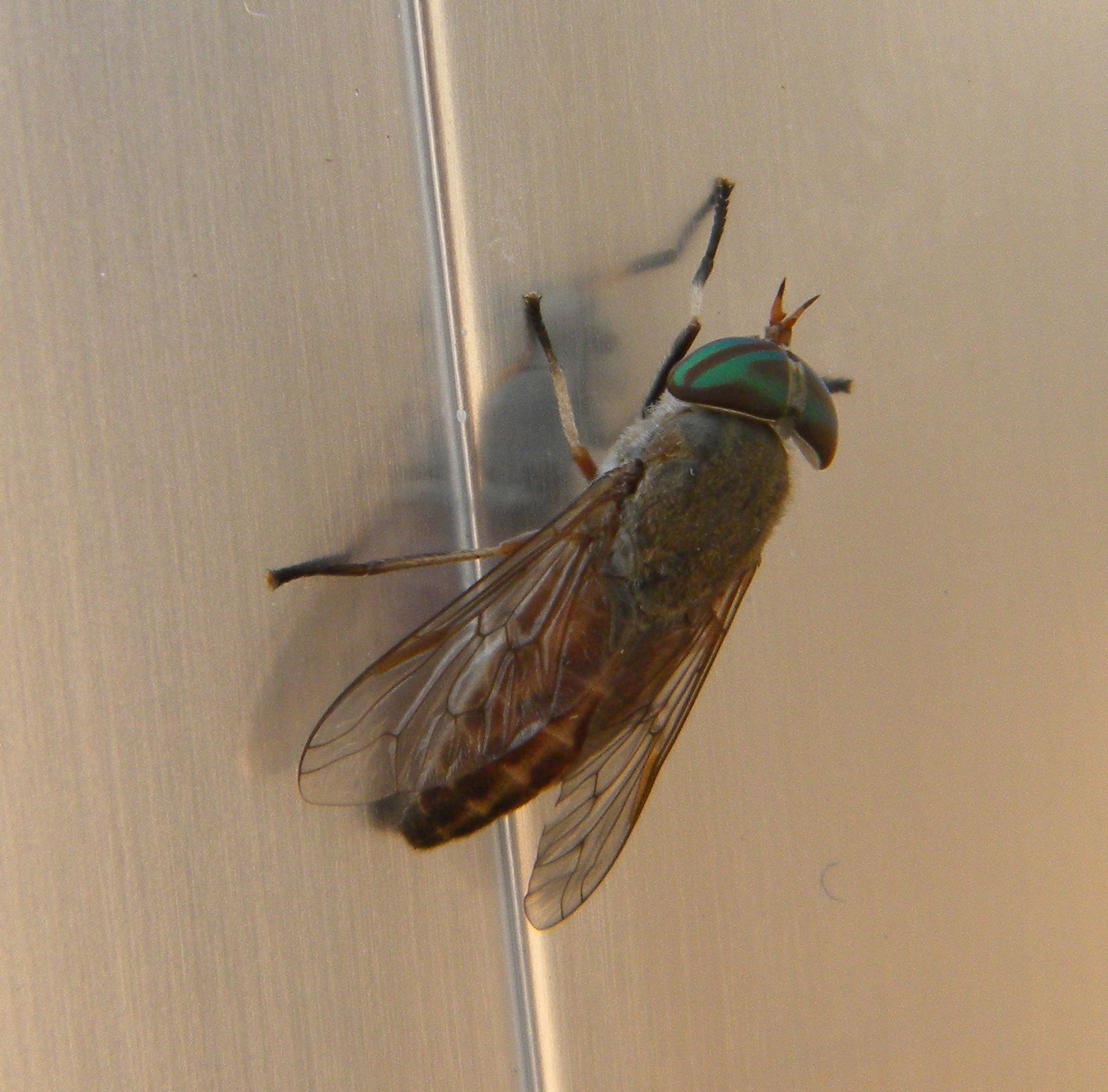
Tabanus nigrovittatus, commonly known as the greenhead horse fly or salt marsh greenhead, is a biting horse fly to coastal salt marshes of the eastern United States. females are aggressive blood-feeders that require vertebrate blood for production, while males do not feed on blood. The species is smaller than most horse flies, approximately the size of a house fly. Larvae develop in intertidal salt marsh mud for one to two years, preying on other . Adults emerge in late spring and are most active from late June through August. The species is a significant human and animal pest, with managed through black box traps rather than due to ecological concerns.


Pronunciation
How to pronounce Tabanus nigrovittatus: /təˈbeɪnəs ˌnɪɡroʊvɪˈtɑːtəs/
These audio files are automatically generated. While they are not always 100% accurate, they are a good starting point.
Identification
Distinguished from other horse flies by its smaller size (house fly-sized versus larger in most Tabanus), emerald-green , and strict association with coastal salt marsh . Females can be separated from males by their separated eyes and prominent biting mouthparts. Similar include Tabanus simulans, with which it shares habitat; accurate separation may require examination of morphological details. The combination of green eyes, dark body with pale markings, and salt marsh occurrence is diagnostic.
Images
Habitat
Strictly associated with coastal salt marshes and tidal wetlands. Larvae develop in the intertidal mud of salt marshes. are found in marsh areas and adjacent inland zones where females seek blood meals. Marsh drainage and hydrology significantly influence larval distribution and survival.
Distribution
Eastern coastal United States, from New England south through the mid-Atlantic and southeastern coasts. Specifically documented from North Carolina (including Ocracoke Island), New Jersey, and other Atlantic coastal states. Distribution is tightly linked to coastal salt marsh .
Seasonality
emerge in late spring. Peak activity occurs from late June through August. Females may remain active and seek blood meals for up to four weeks after initial -laying. Larval stage lasts one to two years in marsh mud.
Diet
females feed on vertebrate blood, which is required for production. They cut skin with scissor-like mouthparts and suck blood from the wound. Adult males do not feed on blood; they likely feed on nectar or other sugar sources, though specific male diet is not well documented. Larvae are predatory, feeding on other in salt marsh mud.
Host Associations
- Humans - blood Aggressive biter; significant pest
- Mammals (various) - blood Domestic and wild mammals
Life Cycle
are laid on grass in salt marshes. Larvae live in intertidal mud of salt marshes for one to two years, preying on . occurs in early spring. emerge in late spring. Females mate and lay first egg batch in marsh, then fly inland to seek blood meals for subsequent egg batches. Females live three to four weeks and lay approximately 100–200 eggs per blood meal.
Behavior
Females are , aggressive blood-feeders. They use visual cues to locate , showing strong attraction to large, dark, solid objects against light backgrounds. Males form hovering near sites to intercept females for mating. Females exhibit directed from marshes inland to seek hosts, returning to marshes to lay . Both sexes show spectral sensitivity in violet to green range, with UV sensitivity; older females are substantially more sensitive than young females.
Ecological Role
Larvae function as in salt marsh benthic . serve as blood-feeding pests that may influence vertebrate . The is a significant component of salt marsh biodiversity and has been used as a model organism for studying tabanid physiology and behavior. Associated microbiome includes and Spiroplasma litorale, a bacterium first isolated from this species.
Human Relevance
Major biting pest of humans and animals in coastal areas. Bites are painful and cause itching due to the cutting-sucking feeding mechanism. are managed using black box traps in marsh areas; use is avoided due to ecological damage concerns. The has been extensively studied for sensory physiology, feeding , and research.
Similar Taxa
- Tabanus simulans sharing salt marsh ; morphologically similar and requiring detailed examination for separation
- Other Tabanus speciesLarger body size in most other ; T. nigrovittatus is notably smaller, house fly-sized
More Details
Sensory Physiology
Extensively studied for spectral sensitivity. Females have broad sensitivity from violet to green (440–520 nm rhodopsins), while males show narrower sensitivity with enhanced blue sensitivity. Older females are 93 times more sensitive than 1-day-old females. UV sensitivity averages 67% of maximum sensitivity across both sexes.
Feeding Physiology
Research demonstrates that meal destination (crop versus ) depends on dissolved solids concentration and phagostimulant type. High sucrose concentrations (1 M) are directed to the crop, while lower concentrations go to the midgut. feeding triggers different routing patterns. Serotonin immunoreactivity in the CNS and midgut suggests neural regulation of feeding .
Microbiome
endosymbionts. Was the source of the first isolation of Spiroplasma litorale, a wall-less bacterium from the gut (strain TN-1 from Ocracoke Island, North Carolina, 1983).
Sources and further reading
- BugGuide
- Wikipedia
- GBIF taxonomy match
- NCBI Taxonomy
- Catalogue of Life
- Diptera | Beetles In The Bush | Page 3
- Spatial Distribution of Hovering Male Tabanus nigrovittatus (Diptera: Tabanidae)
- Spectral sensitivity of the horse fly Tabanus nigrovittatus (Diptera: Tabanidae)
- Effect of Salt Marsh Drainage on the Distribution of Tabanus nigrovittatus (Diptera: Tabanidae)
- The importance of pattern in visual attraction of Tabanus nigrovittatus Macquart (Diptera: Tabanidae)
- Electrophysiological Recordings from the Taste Chemosensilla of Tabanus nigrovittatus (Diptera: Tabanidae) and Determination of Behavioral Tarsal Acceptance Thresholds
- Comparison Between Tsetse Fly Synthetic Diet and Bovine Blood on Reproduction and Survivorship in Tabanus nigrovittatus (Diptera: Tabanidae)
- Destination of the Meal and the Effect of a Previous Sugar or Blood Meal on Subsequent Feeding Behavior in Female Tabanus nigrovittatus (Diptera: Tabanidae)1
- Factors Affecting Engorgement Behavior in the Salt Marsh Horse Fly, Tabanus nigrovittatus Macquart (Diptera: Tabanidae)
- Occurrence of Serotonin Immunoreactivity in the Central Nervous System and Midgut of Adult Female Tabanus nigrovittatus (Diptera: Tabanidae)
- Relationship between Female Size, Type of Egg Mass Deposited, and Description of the Oviposition Behavior of the Sibling Species Tabanus nigrovittatus and T. simulans (Diptera: Tabanidae)1
- Status of Some Names Associated with the Salt Marsh Greenhead Fly, Tabanus nigrovittatus Macquart (Diptera: Tabanidae) in Eastern Coastal North America and Lectotype Designation for T. conterminus Walker
- Complete Genome Sequence of Spiroplasma litorale TN-1 T (DSM 21781), a Bacterium Isolated from a Green-Eyed Horsefly ( Tabanus nigrovittatus )
- Feeding behaviour of the horsefly Tabanus nigrovittatus (Diptera: Tabanidae): effects of dissolved solids on ingestion and destination of sucrose or ATP diets
- Greenhead (Tabanus nigrovittatus) Wolbachia and Its Microbiome: A Preliminary Study.