
Tabanus lineola
Fabricius, 1794
striped horse fly
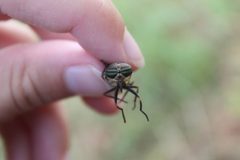
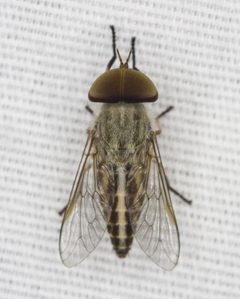
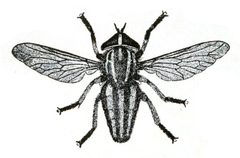
Tabanus lineola, commonly known as the striped horse fly, is a biting horse fly native to eastern and southern North America. Females are aggressive blood-feeders of humans and livestock, recognized by a pale stripe on the , while males lack this feature, do not bite, and have bare . The has a with larvae developing in saturated sandy soils near water bodies.
Pronunciation
How to pronounce Tabanus lineola: /tɑːˈbeɪnəs lɪˈniːoʊlə/
These audio files are automatically generated. While they are not always 100% accurate, they are a good starting point.
Identification
Females possess a distinct pale stripe on the that males lack. Males have bare without hair, while females have hairy eyes. Females have biting mouthparts; males do not bite.
Images
Habitat
Larvae develop in saturated sandy soils near water margins, including ponds, streams, and marshy areas. occur in vicinity of larval .
Distribution
Eastern and southern United States; Gulf coast of Mexico. Records include Louisiana and Vermont.
Seasonality
Active from spring through fall with peak abundance in late summer.
Diet
Females require blood meals for development and bite humans and livestock. Males feed on nectar only and do not bite.
Life Cycle
(one per year). laid in masses on vegetation overhanging water. Larval development takes 3-4 months with as final instar larvae in soil. Complete with egg, larval, pupal, and stages.
Behavior
biting activity by females. Persistent biting when seeking blood meals. Strong capability for location. Males do not bite.
Ecological Role
are biting pests of livestock and wildlife. Larvae function as or scavengers in soil . Potential mechanical of .
Human Relevance
Significant pest of livestock and humans due to aggressive biting by females.
Similar Taxa
- Tabanus atratusBoth are large black horse flies, but T. atratus lacks the pale abdominal stripe and has distinctively hooked .
- Tabanus americanusLarger (up to 30 mm) without the pale abdominal stripe characteristic of T. lineola females.
Sources and further reading
- BugGuide
- Wikipedia
- GBIF taxonomy match
- iNaturalist taxon
- NCBI Taxonomy
- Catalogue of Life
- Diptera | Beetles In The Bush | Page 7
- T.G.I.Flyday—Black horse fly (Tabanus atratus) | Beetles In The Bush
- March | 2019 | Beetles In The Bush
- Bug Eric: Spider Sunday: Striped Lynx Spider
- The Biology of Tabanus lineola lineola F.1,2
- The Biology of Tabanus Lineola Fabr.*