
Syrphus knabi
Shannon, 1916
Eastern Flower Fly
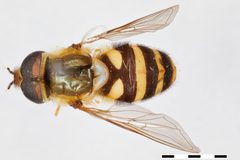
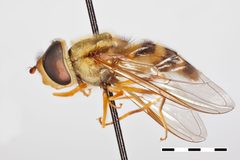
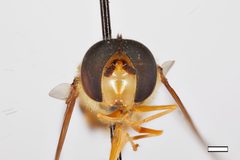
Syrphus knabi is an uncommon of syrphid fly found in eastern North America. are medium-sized hover flies, 7.2–12.9 mm in length, with distinctive yellow and black banded and sexually dimorphic coloration. The species is a known in its larval stage.
Pronunciation
How to pronounce Syrphus knabi: //ˈsɪrfəs ˈknɑːbaɪ//
These audio files are automatically generated. While they are not always 100% accurate, they are a good starting point.
Identification
Distinguished from similar Syrphus by abdominal banding pattern: second segment band broken centrally and extending onto first segment laterally, versus continuous bands in some . Male and specific coloration (yellow with brown spots) separate from females and other species. Hind yellow with half mostly brownish and black hairs anteriorly; hind tibiae darkened on outer side of apical half with black pile. First tarsomere of hind leg mostly or entirely orange above.
Images
Habitat
Associated with flowering vegetation where feed on nectar and pollen. Larval in trees where colonies occur.
Distribution
Eastern United States and Canada. Specific records include Vermont.
Diet
feed on nectar and pollen from flowers. Larvae are of aphids in trees.
Life Cycle
Complete with , three larval instars, pupa, and stages. Female lays eggs in or near colonies. Larvae pass through three instars before pupating; pupa is convex and pear-shaped, attached to leaf, stem, or other substrate.
Behavior
exhibit hovering typical of syrphid flies.
Ecological Role
Larvae function as agents of in trees. serve as while feeding on nectar and pollen.
Human Relevance
Similar Taxa
- Syrphus opinatorSimilar size, coloration, and abdominal banding; distinguished by range and subtle morphological differences in band continuity and leg coloration
- Other Syrphus speciesShare yellow-and-black banded pattern; S. knabi distinguished by specific band shape on second abdominal segment and hind leg coloration