
Allograpta exotica
(Wiedemann, 1830)
Exotic Streaktail
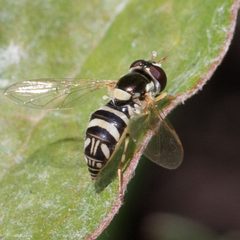
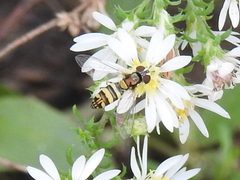
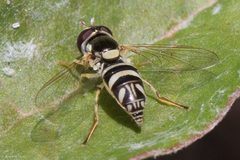
Allograpta exotica is a hoverfly (Syrphidae) widely distributed across the Americas, from the United States to Argentine Patagonia. The larvae are predatory, feeding on soft-bodied arthropods including aphids and , and have been studied as potential agents for agricultural pests. serve as and are commonly associated with fruit and vegetable crops. The completes development from to adult in approximately 15 days, with adults living about 10 days.
Pronunciation
How to pronounce Allograpta exotica: //ˌæloʊˈɡræptə ɛkˈsɒtɪkə//
These audio files are automatically generated. While they are not always 100% accurate, they are a good starting point.
Images
Habitat
Horticultural and agricultural environments, particularly fruit and vegetable crops. In Argentina, documented from strawberry crops in agro-ecological sites without agrochemical inputs. Associated with decaying vegetation and humid temperate areas where prey occur.
Distribution
Widely distributed in the Americas from the United States to Argentine Patagonia. Documented from the Horticultural Green Belt of La Plata, Buenos Aires, Argentina (35°01'21.3"S 58°03'25.5"W). GBIF records indicate presence across Brazil (all states), Norway, and Hawaii, United States.
Diet
Larvae are predatory on soft-bodied arthropods, specifically documented consuming Myzus persicae (green peach aphid) and Frankliniella gemina (). Second instar larvae have been observed to consume four times more thrips than aphids. feed on nectar and pollen.
Life Cycle
Complete with three larval instars. Development from to requires approximately 15 days. Adult lifespan is approximately 10 days. Larval instars show differential consumption rates, with second instars particularly efficient at .
Behavior
Larvae exhibit predatory with demonstrated preference for Myzus persicae over Frankliniella gemina, even when relative availability decreases. All three larval instars kill more than aphids in laboratory conditions, though aphid preference persists.
Ecological Role
agent in agricultural , functioning as a of aphids and in fruit and vegetable crops. contribute to pollination.
Human Relevance
Evaluated as a biocontrol agent for managing agricultural pests, particularly aphids and in horticultural systems. The ' varies across larval stages, with implications for programs.
Sources and further reading
- BugGuide
- Wikipedia
- GBIF taxonomy match
- iNaturalist taxon
- NCBI Taxonomy
- Creepy Crawly Crustaceans | Beetles In The Bush
- An extendable handle for insect nets | Beetles In The Bush
- A new wild strain of Caenorhabditis elegans associated with Allograpta exotica (Syrphidae) in Argentina: an update of its ecological niche and worldwide distribution
- Consumption and preference rates of the various larval stages of Allograpta exotica as biological control agents of Myzus persicae and Frankliniella gemina