
Trichopsomyia
Williston, 1888
Species Guides
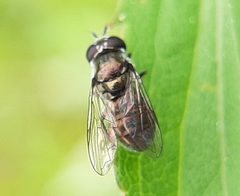
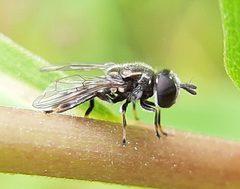
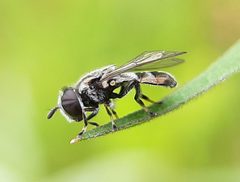
1- Trichopsomyia banksi(White-faced Psyllid-killer)
Trichopsomyia is a of hoverflies ( Syrphidae) established by Williston in 1888. The genus contains approximately 30 described distributed across multiple continents. are typical hoverflies with large and a single pair of wings. Larvae are flattened, legless, and . The genus belongs to the tribe Pipizini within Eristalinae.
Pronunciation
How to pronounce Trichopsomyia: /ˌtrɪkoʊpˈsoʊmiə/
These audio files are automatically generated. While they are not always 100% accurate, they are a good starting point.
Identification
Distinguished from other hoverfly by a combination of characters associated with the Pipizini tribe, including specific wing venation patterns and male genitalia structure. The genus lacks the strongly -waisted form seen in some mimetic syrphid genera. -level identification requires examination of fine morphological details including leg bristle patterns and genitalia, reflected in species epithets such as 'flavitarsis' (yellow ) and 'nigritarsis' (black tarsi).
Images
Appearance
possess large with prominent and small . Body form ranges from medium to slender, with a waist that is not strongly constricted. Wings are clear and single-paired (characteristic of Diptera). Some exhibit yellow and black abdominal banding. Larvae are flattened, legless, and maggot-like in form, typically green or brown in coloration.
Habitat
Associated with varied environments where hoverflies occur, including meadows, woodland edges, and anthropogenic landscapes. Specific microhabitat preferences vary by ; some species such as T. litoralis suggest coastal or shoreline associations.
Distribution
Recorded from North America, South America (including Bolivia), Europe (Denmark, Norway, Sweden), Asia (Japan, Russia), and the Caribbean (Antilles). Distribution records indicate broad geographic range with concentration in northern temperate zones.
Seasonality
activity patterns vary by and latitude; temperate species active during spring and summer months. Specific phenological data limited for most species.
Diet
Larvae are and feed on aphids. feeding habits not explicitly documented for this ; adults of related syrphids commonly visit flowers for nectar and pollen.
Life Cycle
Complete with , larval, pupal, and stages. Larvae are flattened, legless, and aphidophagous. Specific duration and stage vary by and are not well documented.
Behavior
exhibit typical hoverfly with hovering capability. Larval behavior includes active on colonies. No specific behavioral studies documented for this .
Ecological Role
Larvae function as agents of . may contribute to pollination through flower visitation, though this has not been quantified for the .
Human Relevance
Potential value in through by larvae. No documented negative impacts. Not a significant pest or .
Similar Taxa
- Other Pipizini generaShare tribal characteristics including wing venation and larval aphidophagy; separation requires detailed morphological examination of genitalia and chaetotaxy.
- Wasp-mimicking Syrphidae (e.g., some Spilomyia, Temnostoma)Similar color patterns in banded ; distinguished by less constricted waist and structural features of the and .
More Details
Taxonomic history
established by Samuel Wendell Williston in 1888 with T. polita as type . Multiple species described by Curran, Fluke, and others in early-to-mid 20th century. Recent descriptions include T. pilosa (van Steenis & Wyatt, 2020). Classification within Pipizini reflects larval aphidophagy and associated morphological traits.
Species diversity
Approximately 30 described with notable diversity in North America and Palearctic regions. Several species epithets reference morphological traits: flavitarsis (yellow ), nigritarsis (black tarsi), longicornis (long ), pilosa (hairy), pubescens (downy).