
Rhopalosyrphus ramulorum
Weems & Deyrup, 2003
Bare-bellied Squeezetail
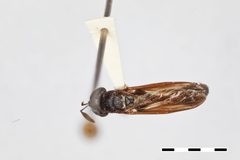
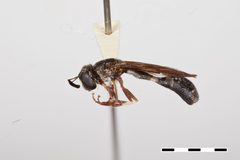
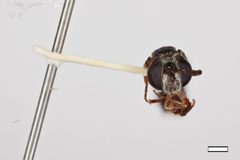
Rhopalosyrphus ramulorum is a of hoverfly in the Syrphidae, described by Weems and Deyrup in 2003. It belongs to the Microdontinae, a group known for their unusual larval involving association with colonies. The species is known by the Bare-bellied Squeezetail. Information about this species remains limited, with only five documented observations on iNaturalist as of the knowledge cutoff.
Pronunciation
How to pronounce Rhopalosyrphus ramulorum: //ˌroʊ.pə.loʊˈsɪr.fəs ˌræm.jəˈlɔː.rəm//
These audio files are automatically generated. While they are not always 100% accurate, they are a good starting point.
Identification
As a member of Microdontinae, may be recognized by the reduced wing venation and compact body form typical of the . The specific epithet "ramulorum" and "Bare-bellied Squeezetail" suggest distinctive abdominal characteristics, though published diagnostic features for separating this from are not readily available in the provided sources. Examination of and original description would be required for definitive identification.
Images
Distribution
Described from material in the United States; specific type locality and full documented range require consultation of the original 2003 description by Weems and Deyrup.
Host Associations
- Ants - larval associationMicrodontinae larvae are known to inhabit colonies, though the specific ant for R. ramulorum has not been documented in the provided sources.
Life Cycle
As with all Microdontinae, development includes , larval, pupal, and stages. Larvae are presumed to be myrmecophilous (-associated), living within ant nests, though direct observations of R. ramulorum larvae have not been reported in the available sources.
Ecological Role
As a member of Microdontinae, larvae likely function as or within colonies, potentially affecting ant colony dynamics or serving as food sources for ants. hoverflies contribute to pollination through nectar feeding, though specific ecological impacts of this remain undocumented.
Similar Taxa
- Rhopalosyrphus guentherii in the same , requiring careful examination of abdominal patterning and other subtle morphological features for separation.
- Other Microdontinae genera such as Microdon and Paramicrodon share reduced wing venation and -associated larvae; separation relies on details of structure, abdominal shape, and male genitalia.
More Details
Taxonomic recency
Described in 2003, this is a relatively recently described , which explains the limited observational data and ecological information available.
Data scarcity
With only five iNaturalist observations, R. ramulorum appears to be rarely encountered or underreported, possibly due to cryptic or difficulty in field identification.