
Volucella evecta
Walker, 1852
Eastern Swiftwing
Volucella evecta, commonly known as the eastern swiftwing, is an uncommon hoverfly native to eastern North America. Once considered a of Volucella bombylans, genetic evidence has established it as a distinct . This species exhibits , closely resembling bumble bees to avoid . are known that visit flowering plants including Geum, Viburnum, and Rubus.
Pronunciation
How to pronounce Volucella evecta: //voʊˈluːˌsɛlə ɪˈvɛktə//
These audio files are automatically generated. While they are not always 100% accurate, they are a good starting point.
Identification
Distinguished from Volucella bombylans by genetic and subtle morphological differences; historically treated as but now recognized as distinct. Distinguished from actual bumble bees (Bombus spp.) by having only one pair of wings (two in bees), short stubby with (bees have longer, elbowed antennae), and absence of a stinger. Resembles Bombus pensylvanicus, Bombus affinis, Bombus bimaculatus, and Habropoda laboriosa. The wing venation with closed marginal and curved M1 cross-, combined with the dark brown wing spot, aids identification.
Images
Appearance
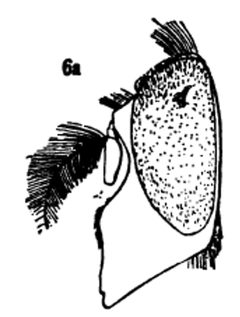
A medium-sized hoverfly measuring 13–18 mm in length. The has a black with yellow pile and a black to chestnut , also with yellow pile; the face is excavated below the in profile. The antennae feature an elongate dark red with a long, densely . are pilose and contiguous in males. The is entirely black with yellow pile covering the ; the scutellum is yellow with yellow pile, and the are yellow pilose anteriorly. The wings have a closed marginal , with the cross- M1 curving basally and a dark brown spot on the wing. Legs are black with black pile. The is black with black pile except for the second segment, which is covered with yellow pile.
Habitat
Found in flowering where food sources occur. Specific habitat preferences are not well documented, but the occurs in areas supporting its adult plants and presumably near or nests required for larval development.
Distribution
Eastern North America and Canada, ranging from Georgia north to New Brunswick.
Diet
feed on nectar and pollen from flowering plants including Geum, Viburnum, Rubus, and other flowering plants. Larval diet unknown for this , but congeneric larvae feed on debris and larvae in and nests.
Host Associations
- Geum - food plantnectar and pollen source
- Viburnum - food plantnectar and pollen source
- Rubus - food plantnectar and pollen source
Life Cycle
Complete with , larva, pupa, and stages. Larval unknown for this , but based on -level knowledge, larvae likely develop as in nests of bumble bees or social , feeding on nest debris and larvae.
Behavior
are flower visitors and . The exhibits of bumble bees, gaining protection from visually hunting that avoid stinging insects. typical of hoverflies, with hovering capability.
Ecological Role
function as , transferring pollen between flowers of various plant . As a member of the Volucellini tribe, larvae likely serve as or in and nests, though this has not been directly observed for this species.
Human Relevance
Contributes to pollination of wild and cultivated flowering plants. No known negative impacts; the mimicry may cause temporary alarm but the cannot sting.
Similar Taxa
- Volucella bombylansFormerly considered ; distinguished by genetic evidence and subtle morphological differences
- Bombus pensylvanicusVisual mimic; distinguished by having two pairs of wings, longer elbowed , and a stinger
- Bombus affinisVisual mimic; distinguished by having two pairs of wings, longer elbowed , and a stinger
- Bombus bimaculatusVisual mimic; distinguished by having two pairs of wings, longer elbowed , and a stinger
- Habropoda laboriosaVisual mimic; distinguished by having two pairs of wings and different structure
More Details
Taxonomic history
Long treated as a of Volucella bombylans, but molecular studies have demonstrated it is a distinct . Part of the Volucella bombylans , which may contain additional cryptic species.
Conservation status
Described as uncommon; trends and specific threats not well documented.
Sources and further reading
- BugGuide
- Wikipedia
- GBIF taxonomy match
- iNaturalist taxon
- NCBI Taxonomy
- Catalogue of Life
- This Hover Fly Engages in Identity Theft | Bug Squad
- Bug Squad
- Hide the Cactus! | Bug Squad
- A bee or not a bee? That is the question! Syrphid fly, Volucella bombylans — Bug of the Week
- Meet six unsung heroes of the pollination world - Buglife Blog - Buglife
- Archive — Bug of the Week