
Rhingia nasica
Say, 1823
American Snout Fly
Rhingia nasica is a North American of hoverfly in the Syrphidae. are recognized by their distinctive elongated snout, a trait shared with other members of the Rhingia. Larval development occurs in association with animal . The species is commonly observed across the eastern and central United States.

Pronunciation
How to pronounce Rhingia nasica: /ˈrɪn.dʒi.ə ˈnæs.ɪ.kə/
These audio files are automatically generated. While they are not always 100% accurate, they are a good starting point.
Identification
The prominent elongated snout distinguishes Rhingia nasica from all other North American syrphid except Rhingia. Within the genus, separation from the introduced European Rhingia campestris requires examination of subtle morphological characters; R. nasica is the only native North American species in this genus.
Images
Appearance
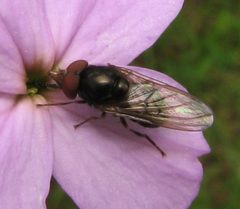
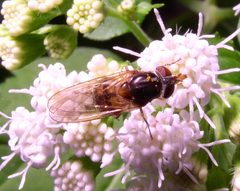
possess a conspicuously elongated, forward-projecting snout (rostrum) that is diagnostic for the . The body is compact with typical syrphid proportions. Coloration and pattern details are not well documented in available sources.
Habitat
Associated with environments where animal occurs, suggesting pastures, meadows, and other open with grazing mammals or livestock.
Distribution
Recorded from the United States, with specific mentions of Vermont and broader North American distribution. The appears to be concentrated in the eastern and central regions of the continent.
Diet
Larvae develop in animal . feeding habits are not documented in available sources.
Host Associations
- animal dung - larval Larvae are associated with of grazing animals
Life Cycle
Larval stage develops in animal . Details of deposition, , and are not documented.
Ecological Role
Larvae contribute to decomposition and nutrient cycling in pasture and meadow . may serve as , though this has not been specifically documented for this .
Human Relevance
No documented economic or medical significance. The 'American Snout Fly' reflects its distinctive appearance.
Similar Taxa
- Rhingia campestrisThe only other Rhingia likely to be encountered in North America; introduced from Europe and distinguished by subtle morphological differences from the native R. nasica.
More Details
Taxonomic note
Catalogue of Life lists this as a synonym, though GBIF and NCBI treat it as accepted. This may reflect ongoing taxonomic evaluation or database synchronization issues.