
Temnostoma venustum
Williston, 1887
black-banded falsehorn
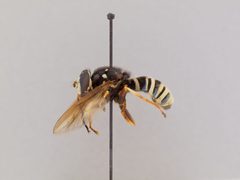
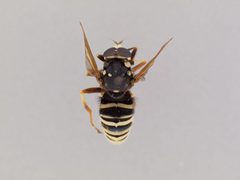
Temnostoma venustum is a rare syrphid fly (flower fly) found in the northeastern United States and adjacent Canada. are mimics with darkened wing margins and leg-waving that simulates wasp . Larvae develop in moist decayed wood.

Pronunciation
How to pronounce Temnostoma venustum: /tɛmˈnɔstɔma vɛˈnʊstʊm/
These audio files are automatically generated. While they are not always 100% accurate, they are a good starting point.
Identification
in the Temnostoma are distinguished by darkened leading wing margins that mimic the folded wings of vespid at rest. They wave their front legs in front of the to simulate wasp , compensating for their short dipteran antennae. Specific identification of T. venustum requires detailed examination.
Images
Habitat
Woodland edges and forested areas with moist decayed wood for larval development. frequent flowers.
Distribution
Northeastern United States and adjacent Canada. Documented from Vermont.
Diet
feed on nectar and pollen from flowers. Larval diet in decayed wood is not specified for this .
Life Cycle
Larvae burrow in moist decayed wood. stage visits flowers.
Behavior
exhibit -mimicry : waving front legs to simulate wasp . is nearly motionless hovering typical of syrphid flies.
Ecological Role
may contribute to pollination through flower visitation. Larvae contribute to wood decomposition.
Similar Taxa
- Temnostoma spp.Other in share -mimicry traits including darkened wing margins and leg-waving ; require microscopic examination for separation.
- Sphecomyia vittataAnother syrphid mimic with longer, thicker than Temnostoma; distinguished by more robust antennal mimicry rather than leg-waving.
- Ancistrocerus spp. (mason wasps)The putative model for Temnostoma mimicry; distinguished by true features including long , two pairs of wings, and stinging capability.
More Details
Mimicry sophistication
Temnostoma flies carry mimicry to extreme lengths, including behavioral mimicry through leg-waving that compensates for the morphological limitation of short dipteran .