
Temnostoma excentrica
(Harris, 1862)
Black-spotted Falsehorn
A North American syrphid fly remarkable for its elaborate mimicry of solitary mason wasps. The darkens the leading edge of its wings to simulate the folded wings of vespid and waves its forelegs to imitate wasp . It is one of several Temnostoma species known for pushing to exceptional lengths.
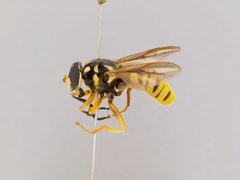
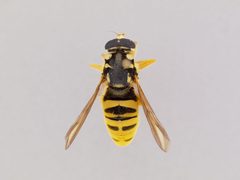
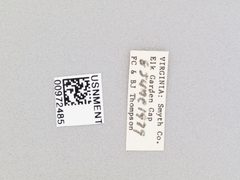
Pronunciation
How to pronounce Temnostoma excentrica: /tɛmˈnɒstəmə ɛkˈsɛntrɪkə/
These audio files are automatically generated. While they are not always 100% accurate, they are a good starting point.
Identification
Darkened leading wing edge distinguishes Temnostoma from most other syrphid flies; within , specific identification of T. excentrica requires examination of diagnostic characters not detailed in general sources. The foreleg-waving is diagnostic for the genus. Separated from actual mason wasps by single pair of wings (Diptera), though this requires close observation.
Images
Habitat
Woodland edges where jewelweed (Impatiens) and other vegetation provide basking sites. Associated with forest-lawn transitions and areas with dead wood.
Distribution
Eastern North America; documented in Illinois and inferred within range of . Specific range boundaries not well-delineated in available sources.
Seasonality
active in mid-May in Illinois; likely spring through summer period corresponding with of models.
Life Cycle
Larval not specifically documented for T. excentrica; related syrphid larvae in Milesiinae typically develop in decaying wood or plant matter.
Behavior
Performs deliberate foreleg-waving in front of to simulate . Basks on leaves, particularly jewelweed. not specifically described for this but noted for wasp-like flight patterns.
Ecological Role
as ; contributes to mimicry complex that may influence learning and dynamics. Larval role in wood decomposition inferred from patterns but not confirmed.
Human Relevance
Contributes to natural mimicry complexes studied in behavioral ; no direct economic significance documented.
Similar Taxa
- Temnostoma spp.Share darkened wing edges and foreleg-waving ; require detailed examination for separation
- Ancistrocerus spp. (mason wasps)Visual model for mimicry; distinguished by two pairs of wings, actual stinging capability, and non-waving
- Sphecomyia vittataAnother advanced syrphid mimic, but with elongated actual rather than simulated ones
More Details
Mimicry specialization
Among the most specialized antennal mimicry known in Diptera; the foreleg-waving represents an evolutionary elaboration beyond static morphological resemblance.