
Cynorhinella longinasus
Shannon, 1924
Eastern Longnose Fly
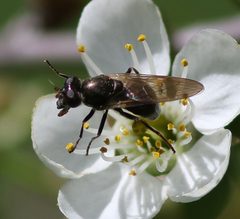
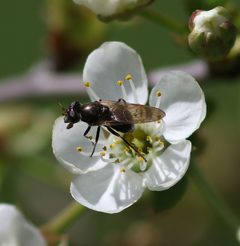
Cynorhinella longinasus, the Eastern Longnose Fly, is a rare of syrphid fly first described by Shannon in 1924. are small, black flies with a distinctive elongated conical . The species has been documented in a limited geographic range in the northeastern United States. Larval remains unknown.
Pronunciation
How to pronounce Cynorhinella longinasus: //ˌsaɪ.noʊ.rɪˈnɛl.lə ˌlɒn.dʒɪˈneɪ.səs//
These audio files are automatically generated. While they are not always 100% accurate, they are a good starting point.
Identification
The projecting conical is diagnostic and distinguishes this from all other northeastern syrphid flies. The combination of small size (5.5–7 mm), entirely black body, and elongated facial projection separates it from and similar black syrphid species such as Paragus or Melanogaster. The face projection is more pronounced than in the related Rhingia, which has a snout-like but less conical facial structure.
Images
Appearance
are 5.5–7 mm in length. Body coloration is black. The most distinctive feature is a prominent conical, projecting that extends forward from the , giving the its . This elongated facial structure is unusual among syrphid flies and serves as a key diagnostic character.
Distribution
Documented from New York, Pennsylvania, and the New England states. The restricted range and few observations suggest it may be genuinely rare or undercollected.
Diet
feed on nectar and pollen from flowers. Larval diet unknown.
Life Cycle
Larval stage unknown. period undocumented.
Behavior
have been observed hovering near flowers, a common to syrphid flies.
Ecological Role
likely contribute to pollination through flower visitation. Larval ecological role cannot be determined.
Human Relevance
No known economic or medical significance. Rarity makes it a of potential interest to dipteran and conservation biologists monitoring northeastern insect fauna.
Similar Taxa
- Rhingia speciesAlso possess an elongated facial projection, but Rhingia has a broader, less conically tapered snout and different wing venation.
- Paragus speciesSmall black syrphids, but lack the projecting conical and have different abdominal shape.
- Melanogaster speciesSmall dark syrphids with compact ; not projecting.
More Details
Taxonomic history
Described by Raymond Corbett Shannon in 1924. The Cynorhinella is small and poorly known, with this being among the least documented members.
Data deficiency
Only five observations recorded on iNaturalist as of source date. The complete absence of larval records represents a significant gap in biological knowledge for this .