
Anasimyia chrysostoma
(Wiedemann, 1830)
Lump-legged Swamp Fly
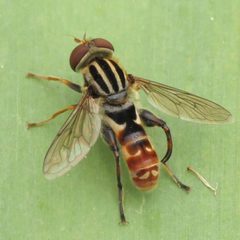
Anasimyia chrysostoma, commonly known as the lump-legged swamp fly, is a syrphid fly distributed across the United States and Canada. are flower visitors that feed on nectar and pollen. The larvae are aquatic and possess the characteristic rat-tailed typical of the Anasimyia. The species is considered fairly common and has been documented in 355 observations on iNaturalist.
Pronunciation
How to pronounce Anasimyia chrysostoma: //ˌænəˈsɪmiə kraɪˈsɒstəmə//
These audio files are automatically generated. While they are not always 100% accurate, they are a good starting point.
Identification
The can be identified by its status as a syrphid fly with the -specific trait of rat-tailed aquatic larvae. The "lump-legged swamp fly" suggests distinctive leg , though specific diagnostic features for separating it from are not documented in available sources. may be recognized by their flower-visiting and hoverfly pattern, but species-level identification likely requires examination of morphological details not specified here.
Images
Habitat
Larvae inhabit aquatic environments. are associated with flowers in areas near larval .
Distribution
United States and Canada.
Diet
feed on nectar and pollen from flowers. Larval diet is not specified in available sources.
Life Cycle
Larvae are of the rat-tailed type and develop in aquatic environments. Specific details on , timing, or voltinism are not documented.
Behavior
are commonly found on flowers. Hoverflies in this can remain nearly motionless in , though this specific capability has not been independently documented for A. chrysostoma.
Similar Taxa
- Other Anasimyia speciesShare aquatic rat-tailed larvae and general syrphid ; -level separation requires detailed examination
- Other Syrphidae with aquatic larvaeConvergent aquatic larval adaptations; may be distinguished by flower association patterns and morphological details