
Palpada albifrons
(Wiedemann, 1830)
White-faced Plushback
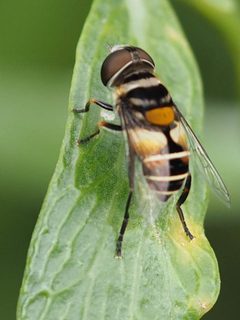
Palpada albifrons is a rare of syrphid fly (hoverfly) characterized by its distinctive white-faced appearance and aquatic larval stage. are medium-sized flower flies commonly found on flowers, where they feed on nectar and pollen. The species has a disjunct distribution, occurring from Mexico northward along coastal areas of the United States, with additional records from South America. The larvae are aquatic rat-tailed maggots that inhabit organic-rich standing water.


Pronunciation
How to pronounce Palpada albifrons: /pælˈpɑːdə ælbiˈfrɒnz/
These audio files are automatically generated. While they are not always 100% accurate, they are a good starting point.
Identification
Distinguished from similar Palpada and Eristalis by the combination of: white-pollinose with thick white pile; distinct grayish thoracic band with oblique lateral spots; yellow scutellum with black base; and specific wing venation with R1 and curved R4+5. The abdominal pattern, particularly the confluent reddish-yellow spots on the third segment and the interrupted shining fascia on the fourth segment, aids identification. Male and female dichoptic eyes with distinct thoracic banding pattern provide additional diagnostic characters.
Images
Appearance
Length 8–9 mm. covered with dense white pollen and thick white pile, most conspicuous on frontal triangle; facial stripe and gena shining black. pilose, in males. obscurely reddish-brown with bare . with yellowish-white pile anteriorly, intermixed with blackish pile posteriorly; distinct grayish pollinose broad band to , with oblique spot on each side reaching from wing base toward scutellum. Scutellum yellow with narrowly black base and black pile. with complex pattern: first segment black with yellow outer angles; second segment light yellow with narrow opaque black stripe; third segment with oval reddish-yellow lateral spots confluent with preceding yellow; fourth segment with yellow hind border and narrow interrupted shining fascia. Wings hyaline, sometimes faintly clouded; R1 ; R2+3 with distinct curvature into submarginal cell near end of marginal cell; R4+5 curved. Legs black; hind dilated; joints and basal portions of tibiae light yellow; middle light yellow; extreme base of anterior metatarsi with greenish tinge.
Habitat
occur in flower-rich including gardens, meadows, and coastal areas. Larvae inhabit aquatic environments, specifically organic-rich standing water such as putrid water, saturated organic matter, and water-collecting containers.
Distribution
Mexico northward along coastal areas of the United States. GBIF records indicate additional occurrence in Brazil (Acre, Amazonas, Amapá, Distrito Federal, Espírito Santo, Goiás, Minas Gerais, Mato Grosso do Sul, Mato Grosso, Pará, Paraná, Rio de Janeiro, Rondônia, Roraima, Rio Grande do Sul, Santa Catarina, São Paulo, Tocantins) and Colombia (Santander).
Diet
feed on nectar and pollen from flowers. Larvae are , consuming bacteria and other microbes from organic matter in water.
Life Cycle
Complete . laid in or near aquatic . Larvae are aquatic rat-tailed maggots with into an extensible breathing siphon that connects to the water surface; they filter feed on microorganisms in organic-rich water. Mature larvae seek dry land to pupate; pupal capsule is hard and mouse-shaped. emerge from pupae.
Behavior
are flower visitors and capable of nearly motionless hovering characteristic of syrphid flies. Larvae remain connected to water surface via breathing siphon while filter feeding.
Ecological Role
serve as , transferring pollen while feeding on nectar. Larvae contribute to nutrient cycling in aquatic by processing organic matter and microorganisms.
Human Relevance
are beneficial of wildflowers and cultivated plants. Larvae may occur in water gardens and containers, where they can be mistaken for mosquito larvae; they do not bite or transmit .
Similar Taxa
- Eristalis tenaxSimilar rat-tailed maggot larval and flower-visiting ; distinguished by larger size, different facial coloration, and abdominal pattern lacking the distinct yellow scutellum with black base.
- Palpada vinetorum with similar overall appearance; distinguished by differences in thoracic pile coloration and abdominal pattern details.
- Palpada furcata with overlapping distribution; distinguished by differences in pile and scutellar coloration.