
Palpada vinetorum
(Fabricius, 1799)
Northern Plushback
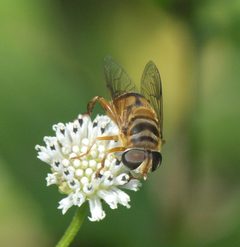
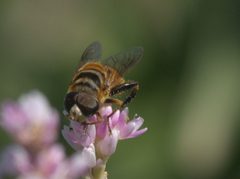
Palpada vinetorum is a of syrphid fly in the Syrphidae, commonly known as the Northern Plushback. It is a medium-sized flower fly native to the Americas, with measuring 10–14 mm in length. The species belongs to the vinetorum species group within the Palpada, one of three groups established by Thompson (1981). Adults are notable that visit flowers, while larvae develop in organic-rich aquatic or semi-aquatic environments. The species is widely distributed across North, Central, and South America.
Pronunciation
How to pronounce Palpada vinetorum: /pælˈpɑːdə vaɪˈniːtɔːrəm/
These audio files are automatically generated. While they are not always 100% accurate, they are a good starting point.
Identification
Distinguished from similar syrphid flies by the combination of: three grayish-olivaceous crescent bands on the ; reddish-yellow scutellum with long yellow pile; complex abdominal pattern with large reddish-yellow lateral spots on segments 2–3 and characteristic shining cross-bands; distinctly dilated hind that are broadly blackish (or sometimes deep red) with blackish tibiae; and sinuate R4+5 with short R1. The vinetorum group can be separated from the scutellaris and agrorum groups within Palpada by morphological characters of the male and female genitalia (detailed in Thompson 1981). Similar species in the Eristalis lack the distinctive crescent banding pattern on the scutum and typically show different abdominal coloration.
Images
Habitat
occur in open areas where flowers are abundant. Larvae develop in putrid, organic-rich standing water including saturated manure, decaying organic matter, and water-collecting containers such as rain gutters and water gardens. The occupies urban, suburban, and rural aquatic environments.
Distribution
Widely distributed in the Americas. North America: primarily Texas and eastern coastal regions of the United States. Central and South America: recorded from Colombia (Bucaramanga, Cimitarra, Villavicencio) and extensively across Brazil (Acre, Alagoas, Amazonas, Amapá, Bahia, Ceará, Distrito Federal, Espírito Santo, Goiás, Maranhão, Minas Gerais, Mato Grosso do Sul, Mato Grosso, Pará, Paraíba, Pernambuco, Piauí, Paraná, Rio de Janeiro, Rio Grande do Norte, Rondônia, Roraima, Rio Grande do Sul, Santa Catarina, Sergipe, São Paulo, Tocantins). Also recorded from Norway (likely introduced or vagrant occurrence).
Diet
feed on nectar and pollen from flowers. Larvae are filter-feeders that consume bacteria and other microbes from organic matter in water.
Life Cycle
laid in or near organic-rich aquatic . Larvae are rat-tailed maggots—aquatic larvae with into an extensible breathing siphon that maintains connection to the water surface, allowing respiration in low-oxygen environments. Larvae filter-feed on microorganisms in decomposing organic material. Upon maturity, larvae leave water to pupate on dry land; pupal capsule is hard and resembles a tiny mouse in shape. emerge from pupae and are capable .
Behavior
are active flower visitors and . Larvae remain submerged using their extensible respiratory siphon to access surface air while feeding below. Mature larvae demonstrate behavioral of leaving aquatic to find dry substrate for .
Ecological Role
function as of wildflowers and cultivated plants. Larvae contribute to decomposition and nutrient cycling in aquatic by processing organic matter and filtering microorganisms. The occupies a role in organic-rich aquatic as both consumer of microbes and prey for other organisms.
Human Relevance
provide pollination services to wildflowers, orchard trees, and landscape plants. Larvae may be encountered in water gardens, rain gutters, compost leachate, and similar organic-rich standing water; presence indicates healthy decomposition processes but may cause concern when found in domestic water containers. Larvae are sometimes found in saturated manure. The is not considered endangered or of conservation concern.
Similar Taxa
- Palpada scutellaris group speciesOther Palpada share dilated hind and general body plan, but differ in abdominal pattern, scutellum coloration, and genitalia ; the scutellaris group specifically has different male and female genitalia characters and typically shows more extensive yellow or orange on the scutellum
- Eristalis tenax (Drone Fly)Also has rat-tailed maggot larvae and similar size, but lacks the three crescent-shaped grayish bands on , has more uniformly colored , and shows different wing venation details; a European introduction to North America now widespread, whereas P. vinetorum is native to the Americas
- Other Eristalis speciesShare aquatic larval and general flower fly , but differ in thoracic patterning, abdominal coloration, and details of wing venation including less sinuate R4+5