
Palpada agrorum
(Fabricius, 1787)
Double-banded Plushback
Palpada agrorum is a common syrphid fly commonly known as the Double-banded Plushback. are flower visitors that obtain nectar and pollen. Larvae are aquatic filter-feeders of the rat-tailed type, possessing an extensible breathing siphon. The was first described by Fabricius in 1787 and belongs to the agrorum species group within the Palpada.
Pronunciation
How to pronounce Palpada agrorum: //palˈpaː.da aˈɡroː.rum//
These audio files are automatically generated. While they are not always 100% accurate, they are a good starting point.
Identification
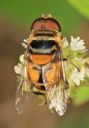
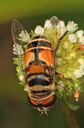
The combination of the double-banded abdominal pattern (yellow second segment with black stripe, black third and fourth segments with yellow markings), yellow scutellum with black base, and grayish pollinose band on the distinguishes this . The closed r2+3 before the wing margin and the curved R2+3 near the marginal cell end are additional diagnostic wing characters. The dilated hind and specific leg coloration (mostly black with yellow at knees and tibial bases) aid identification.
Images
Appearance
display a distinctive abdominal pattern: the second segment is light yellow with a narrow opaque black stripe, the third segment is black with oval reddish-yellow spots on each side, and the fourth segment is black with a yellow hind border and narrow interrupted shining fascia. The scutellum is yellow with a narrowly black base. The is concealed beneath white pollen and thick pure white pile. The is black with yellowish-white pile in front, intermixed with blackish pile behind, and features a conspicuous grayish pollinose broad band in front of the . Wings are hyaline, sometimes faintly clouded in the middle and outer parts, with r2+3 closed before the wing margin and a distinct curvature of the second (R2+3) near the end of the marginal cell. Legs are mostly black with light yellow knees and basal portions of tibiae. Hind are dilated. Males have , pilose ; females differ in having a broadly opaque black middle on the second abdominal segment and narrow interrupted shining fasciae on the third and fourth segments.
Habitat
are found around flowers in various terrestrial . Larvae inhabit aquatic or semi-aquatic environments with organic-rich standing water, including putrid water, saturated organic matter, and water collection sites such as rain gutters and container gardens.
Distribution
North and South America. Most common in the southeastern United States. Recorded throughout much of Brazil including states in the Amazon, Atlantic Forest, Cerrado, and southern regions.
Diet
feed on nectar and pollen from flowers. Larvae are that consume bacteria and other microbes from organic matter in water.
Life Cycle
are laid in organic-rich aquatic or semi-aquatic environments. Larvae are rat-tailed maggots with an extensible breathing siphon that maintains connection to the water surface. Larvae filter feed on microbial matter in the water. Upon maturity, larvae seek dry land to pupate; the pupal capsule is hard and resembles a tiny mouse in shape. emerge from pupae.
Behavior
hover in , a characteristic of syrphid flies. They are commonly observed visiting flowers. Larvae remain at the water surface via their breathing siphon while filter feeding below.
Ecological Role
serve as of wildflowers and cultivated plants. Larvae contribute to nutrient cycling and decomposition in aquatic organic matter. The is not considered threatened or of conservation concern.
Human Relevance
are beneficial as in both natural and agricultural settings. Larvae may be encountered in artificial water containers, rain gutters, and water gardens, sometimes raising questions about management alongside mosquito control measures. The is not known to be a significant pest or to transmit .
Similar Taxa
- Eristalis tenaxBoth are rat-tailed maggot syrphids with similar larval , but E. tenax is a more robust mimic with different coloration and is non-native to the Americas.
- Other Palpada speciesMembers of the scutellaris group share yellow scutellum characteristics; P. agrorum is distinguished by its specific abdominal banding pattern and placement in the agrorum group rather than the scutellaris group.