
Eristalis saxorum
Wiedemann, 1830
Blue-polished Drone Fly
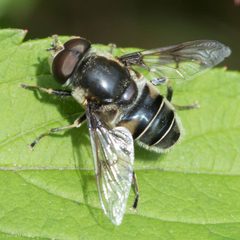
Eristalis saxorum is an uncommon of syrphid fly (hoverfly) native to eastern North America. are flower visitors, obtaining nectar and pollen from blossoms. The species exhibits typical drone fly characteristics, including -mimicry and hovering . Larvae are presumed to be of the rat-tailed type, though they have not been formally identified for this species. The species is active from mid-March through late October, with adults in sheltered locations such as cave entrances.

Pronunciation
How to pronounce Eristalis saxorum: /ɛrɪsˈtaːlɪs saksˈoːrʊm/
These audio files are automatically generated. While they are not always 100% accurate, they are a good starting point.
Identification
Distinguished from other Eristalis by its uncommon status and eastern U.S. distribution. possess the single pair of wings characteristic of Diptera (distinguishing them from the two pairs of Hymenoptera they mimic). The specific epithet 'saxorum' (of rocks) may allude to associations or appearance, though this is not confirmed in available sources. Formal larval identification is lacking, precluding distinction from based on stages.
Images
Habitat
Found in environments supporting flowering plants for foraging. occupy sheltered rocky microhabitats, including crannies around cave mouths.
Distribution
Eastern United States. Specific state records include Vermont.
Seasonality
activity period extends from mid-March to late October. occurs in sheltered locations during winter months.
Diet
consume nectar for energy and pollen as a protein source for development. Specific larval diet unknown; filter bacteria and organic matter from aquatic or semi-aquatic substrates.
Life Cycle
Complete with , larva, pupa, and stages. Larvae are presumed aquatic filter-feeders of the rat-tailed type (possessing an elongated siphon for respiration), though this has not been confirmed for E. saxorum specifically. Adults overwinter in .
Behavior
Exhibits hovering capability characteristic of Syrphidae. overwinter in clusters in sheltered rocky locations. has been observed in Eristalis hoverflies generally; E. saxorum may utilize similar strategies to escape harsh winters, though specific migration patterns are undocumented.
Ecological Role
contribute to pollination through flower visitation. Potential larval role in nutrient cycling in aquatic systems, if rat-tailed maggot applies.
Human Relevance
Minor in gardens and natural landscapes. No documented economic or medical significance.
Similar Taxa
- Eristalis tenaxCommon drone fly with distribution; distinguished by abundance and broader range. E. saxorum is uncommon and restricted to eastern U.S.
- Other Eristalis speciesMany share -mimicry and rat-tailed larval ; precise identification requires examination of subtle morphological features not detailed in available sources.
Sources and further reading
- BugGuide
- Wikipedia
- GBIF taxonomy match
- iNaturalist taxon
- Catalogue of Life
- To Bee or Not to Bee | Bug Squad
- A friendlier type of drone: Common Drone Fly, Eristalis tenax — Bug of the Week
- Bug Eric: Fly Day Friday: Rat-tailed Maggots
- Insect Migration (Part 1) - Buglife Blog - Buglife
- Mudo Pryfed (Rhan 1) - Buglife Blog - Buglife
- Strathmore B-Lines: Surveying Grasslands and Pollinating Insects in the Strathmore Valley - Buglife Blog - Buglife