
Eristalis hirta
Loew, 1866
Black-footed Drone Fly
Eristalis hirta, commonly known as the black-footed drone fly, is a syrphid fly first described by Loew in 1866. It is a common species in Western North America and also occurs in Northern Europe. Like other Eristalis species, it exhibits of honey bees, providing protection from . The larvae are aquatic filter-feeders with the characteristic rat-tailed , developing in standing water .
Pronunciation
How to pronounce Eristalis hirta: /ˌɛrɪˈstæliːs ˈhɜːrtə/
These audio files are automatically generated. While they are not always 100% accurate, they are a good starting point.
Identification
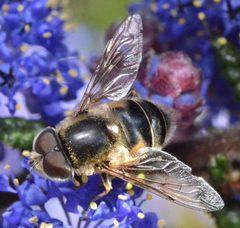
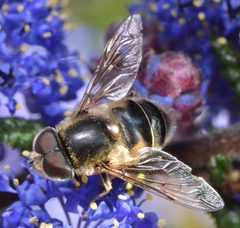
Distinguished from similar Eristalis by the black (except yellow middle leg basitarsi), combined with the specific pattern of yellow on the legs and . The prominent light yellow marginal bands on abdominal segments 2–4 are unusually conspicuous. The broad and in females is a notable . The black-footed refers to the predominantly black tarsi. Separation from Eristalis tenax requires examination of leg coloration: E. hirta has black tarsi with only the middle basitarsi yellow, whereas E. tenax typically shows more extensive yellow on the tarsi.
Images
Appearance
measure 10–15 mm in length. The is shiny black with light brownish yellow pile; in females, the and frons are unusually broad. Facial pile is light brownish yellow except for the shiny black facial stripe () and cheeks. are very dark brownish black with a slightly basally. are contiguous only in males. The is dark, shiny brownish black with yellowish pile; the scutellum is lighter brownish and shiny, with pale yellow pile on the pleurae. Legs are black and yellow: front and middle are black with pale yellow apices; hind femur bases and apices are yellow. Front and hind tibiae are black with basal half or more pale yellow; middle tibia is mostly pale yellow. are all black except the middle leg basitarsi, which are yellow. The is black with yellow bands and spots: segment 2 has large, sharply marked yellow-orange spots on the sides, widely separated by opaque black medially; segments 3 and 4 are shiny black with prominent light yellow marginal bands. Wings are hyaline or very faintly infuscated in the middle and half; pterostigma is small. Veination includes a spurious , looping of R4+5 into r4+5, and closed r2+3.
Habitat
Raised bogs, ditches, and temporary pools. Larval development occurs in aquatic or semi-aquatic environments with organic matter. are commonly found on and around flowers.
Distribution
Western North America and Northern Europe. GBIF records confirm presence in Norway and Sweden.
Diet
feed on nectar for energy and pollen as a protein source for development. Larvae are aquatic filter-feeders, consuming bacteria and other microbes from organic matter in the water.
Life Cycle
Larvae are of the rat-tailed type, possessing an elongated siphon for respiration at the water surface while feeding below. This siphon allows larvae to inhabit low-oxygen environments such as standing water with decaying organic matter. Larvae filter-feed on microorganisms. Mature larvae seek dry land to pupate; the pupal capsule is hard and mouse-shaped. emerge to visit flowers for feeding and . Some Eristalis have been observed in sheltered locations such as cave mouths, though this specific has not been explicitly documented for E. hirta.
Behavior
exhibit hovering typical of syrphid flies. They are important , frequently visiting flowers to obtain nectar and pollen. The exhibits of stinging bees and , which provides protection from visually hunting .
Ecological Role
serve as of flowering plants. Larvae contribute to nutrient cycling in aquatic through filter-feeding on organic matter and microorganisms. The provides a food source for various including insectivorous birds and other animals.
Human Relevance
are beneficial as in gardens and agricultural landscapes. Larvae may occasionally be encountered in water features or containers with organic debris. No significant negative impacts are documented, though related Eristalis can rarely cause myiasis if ingested; this has not been specifically reported for E. hirta.
Similar Taxa
- Eristalis tenaxSimilar -mimic appearance, but E. tenax has more extensive yellow on and different abdominal pattern; distribution versus Western North American and Northern European range of E. hirta.
- Eristalis arbustorumOverlapping range in Europe; distinguished by leg coloration and abdominal pattern details.
Sources and further reading
- BugGuide
- Wikipedia
- GBIF taxonomy match
- iNaturalist taxon
- NCBI Taxonomy
- A friendlier type of drone: Common Drone Fly, Eristalis tenax — Bug of the Week
- Bug Eric: Fly Day Friday: Rat-tailed Maggots
- Insect Migration (Part 1) - Buglife Blog - Buglife
- JIPM Article on Masked Chafer Grubs in Turfgrass Explains Management Techniques
- Mudo Pryfed (Rhan 1) - Buglife Blog - Buglife
- Stories about small insects and making a big difference - Buglife Blog - Buglife