
Eristalis flavipes
Walker, 1849
orange-legged drone fly
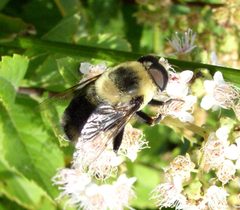
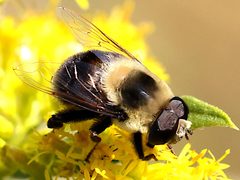
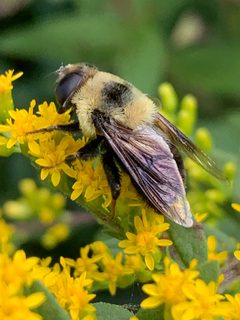
Eristalis flavipes, commonly known as the orange-legged drone fly, is a North American hoverfly in the Syrphidae. are striking mimics of bumblebees, measuring 13–17 mm in length, with abundant bright yellow pile on a black body and distinctive orange-red legs. The is active from early April through mid-October, occurring across diverse with particular affinity for wetlands. Adults visit flowers for nectar and pollen, while larvae are aquatic rat-tailed maggots that filter-feed in standing water.
Pronunciation
How to pronounce Eristalis flavipes: /ˌɛrɪˈsteɪlɪs ˈflævɪˌpiːs/
These audio files are automatically generated. While they are not always 100% accurate, they are a good starting point.
Identification
Distinguished from similar Eristalis by the orange-red coloration of the middle and (legs otherwise black), the dark red second abdominal segment, and the female's large brown wing spot. The combination of bright yellow pile on with black and orange leg segments separates it from other drone flies. Male are broadly contiguous with vertical eye pile stripe; female has diagnostic wing spot.
Images
Habitat
Occurs in a wide variety of with particular affinity for wetlands; includes meadows, gardens, forest edges, and riparian areas
Distribution
Native to North America; recorded from Vermont and other US states
Seasonality
period from early April to mid-October
Diet
feed on nectar and pollen from flowers, particularly members of the aster ; larvae are aquatic filter-feeders
Life Cycle
Complete ; larvae are rat-tailed maggots—aquatic filter-feeders with elongated siphon for respiration in standing water; occurs in aquatic or semi-aquatic ; emerge in spring and are active through autumn
Behavior
hover motionless in ; frequently visit flowers for feeding; known to hibernate in sheltered locations such as caves during winter months
Ecological Role
serve as ; larvae contribute to nutrient cycling in aquatic through filter-feeding; adults exhibit of stinging bees, potentially reducing pressure
Human Relevance
are beneficial in gardens and landscapes; larvae may occasionally contaminate livestock feed or water sources; no significant pest status
Similar Taxa
- Eristalis tenaxCommon drone fly, also a bumblebee mimic, but has more uniformly colored legs without distinct orange segments and lacks the dark red second abdominal segment of E. flavipes
- Eristalis arbustorumAnother North American drone fly, distinguished by different leg coloration and abdominal patterning
Sources and further reading
- BugGuide
- Wikipedia
- GBIF taxonomy match
- iNaturalist taxon
- NCBI Taxonomy
- Catalogue of Life
- Archive — Bug of the Week
- A friendlier type of drone: Common Drone Fly, Eristalis tenax — Bug of the Week
- Ice dams, wet wood, and termites - Reticulitermes flavipes — Bug of the Week
- What lies beneath the mulch? Formosan termite, Coptotermes formosanus, and Eastern subterranean termite, Reticulitermes flavipes — Bug of the Week
- How to raise a crop of termites: Eastern subterranean termites, Reticulitermes flavipes — Bug of the Week
- From the Bug of the Week mailbag, termites or ants? Eastern subterranean termites, Reticulitermes flavipes, or Citronella ants, Lasius sp. — Bug of the Week