
Eristalis bellardii
Jaennicke, 1867
Mexican mountain drone fly
Eristalis bellardii is an uncommon syrphid fly first described in 1867. It is found in the Southwestern United States, Mexico, and Central America. The species exhibits of honeybees, with visiting flowers for nectar and pollen. Larval remains unknown.
Pronunciation
How to pronounce Eristalis bellardii: //ˌɛrɪˈstælis bɛˈlɑrdi.aɪ//
These audio files are automatically generated. While they are not always 100% accurate, they are a good starting point.
Identification
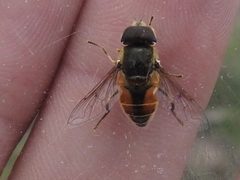
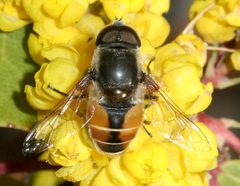
Distinguished from other Eristalis by specific abdominal tergal patterning: second orange on lateral two-thirds, black medially; in third and fourth terga. Male touching versus separated in female. Differs from Eristalis tenax (common drone fly) by less extensive orange coloration and more restricted distribution. Genitalia figure available in original description literature.
Images
Appearance
Medium-sized hoverfly with honeybee-like appearance. black, sometimes reddish-brown laterally with yellowish-white pollen except for shiny central stripe extending nearly to . Gena shiny with pale yellow pile. Frontal lunule reddish-brown. Antenna with bare . pile brownish-yellow, white ventrally. Male eyes touch along center; female eyes separated. black with yellow pile except central scutellum with black pile over reddish-brown base. Wings hyaline with yellow pilose tegula. : first black; second tergum dull orange on lateral two-thirds, black medially; third tergum similar to second in male, female with orange lateral only about one-third width; fourth tergum orange on lateral third in male, entirely black in female.
Habitat
Montane regions of southwestern North America and Central America. Specific microhabitat requirements not documented.
Distribution
Southwestern United States, Mexico, and Central America. Infrequently encountered throughout range.
Seasonality
activity period not specifically documented for this .
Behavior
hover and visit flowers. Larval unknown.
Ecological Role
pollination services likely, based on flower visitation. Specific contributions unstudied.
Similar Taxa
- Eristalis tenaxCommon drone fly with broader distribution and more extensive orange abdominal coloration; versus restricted southwestern range
- Other Eristalis speciesShared characteristics including mimicry, but distinguished by specific abdominal patterning and male configuration
Sources and further reading
- BugGuide
- Wikipedia
- GBIF taxonomy match
- iNaturalist taxon
- Catalogue of Life
- To Bee or Not to Bee | Bug Squad
- A friendlier type of drone: Common Drone Fly, Eristalis tenax — Bug of the Week
- Bug Eric: Fly Day Friday: Rat-tailed Maggots
- Insect Migration (Part 1) - Buglife Blog - Buglife
- Mudo Pryfed (Rhan 1) - Buglife Blog - Buglife
- Strathmore B-Lines: Surveying Grasslands and Pollinating Insects in the Strathmore Valley - Buglife Blog - Buglife