
Eristalis anthophorina
(Fallén, 1817)
orange-spotted drone fly
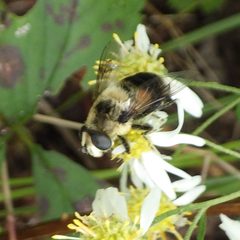
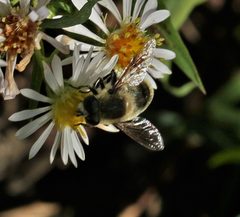
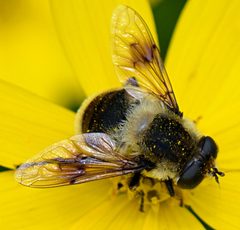
Eristalis anthophorina, the orange-spotted drone fly, is a syrphid fly with Holarctic distribution. reach approximately 15 mm in length and are notable mimics of bumblebees. The is strongly associated with wetland including bogs, fens, and woodland pools. It has been observed visiting flowers of Verbena hastata, Salix myricoides, and Hesperis matronalis.
Pronunciation
How to pronounce Eristalis anthophorina: //ɛrɪˈsteɪlɪs ænθəˈfɔːrɪnə//
These audio files are automatically generated. While they are not always 100% accurate, they are a good starting point.
Identification
Easily confused with bumblebees due to overall appearance and coloration. Distinguished from other Eristalis by: second abdominal segment with broad orange spots laterally (not present in E. tenax); scutellum wholly yellow with dense yellow pile; wing with distinct brownish spot in middle; tibia yellowish at base. The combination of orange-spotted second abdominal segment and yellow scutellum separates this species from other drone flies.
Images
Habitat
Wetlands including bogs, fens, and woodland pools. Strongly associated with standing water and saturated organic substrates typical of these environments.
Distribution
Holarctic distribution. In North America: throughout much of Canada and primarily northern United States. In Europe: widely distributed in northern regions. May be introduced in North America.
Ecological Role
have been observed visiting flowers of Verbena hastata (blue vervain), Salix myricoides (blue-leaved willow), and Hesperis matronalis (dame's rocket), suggesting a role in pollination. Larval presumed similar to other Eristalis (aquatic filter-feeders in organic-rich water), though not explicitly documented for this species.
Similar Taxa
- Eristalis tenaxSimilar bumblebee-mimic appearance, but lacks orange spots on second abdominal segment; scutellum coloration differs; more distribution.
- Bombus spp. (bumblebees)Convergent mimicry in coloration and hair pattern; distinguished by wing number (one pair in flies vs. two pairs in bees), structure, and other dipteran vs. hymenopteran traits.
Sources and further reading
- BugGuide
- Wikipedia
- GBIF taxonomy match
- iNaturalist taxon
- NCBI Taxonomy
- Catalogue of Life
- To Bee or Not to Bee | Bug Squad
- A friendlier type of drone: Common Drone Fly, Eristalis tenax — Bug of the Week
- Bug Eric: Fly Day Friday: Rat-tailed Maggots
- Insect Migration (Part 1) - Buglife Blog - Buglife
- Mudo Pryfed (Rhan 1) - Buglife Blog - Buglife
- Strathmore B-Lines: Surveying Grasslands and Pollinating Insects in the Strathmore Valley - Buglife Blog - Buglife