
Orthonevra nitida
(Wiedemann, 1830)
Wavy Mucksucker
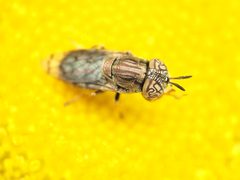
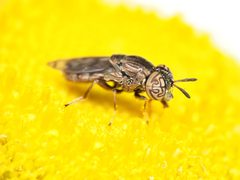
Orthonevra nitida, commonly known as the Wavy Mucksucker, is a small syrphid fly (4–5 mm) native to eastern and central North America. It is one of three Nearctic Orthonevra that extends into the Neotropical region. are flower visitors, obtaining nectar and pollen from blooms. The species exhibits distinctive metallic coloration and wing markings that aid in identification. Larvae of this are of the rat-tailed type, though O. nitida larvae specifically have not been described.

Pronunciation
How to pronounce Orthonevra nitida: /ɔrˈθɒnɛvrə ˈnɪtɪdə/
These audio files are automatically generated. While they are not always 100% accurate, they are a good starting point.
Identification
Distinguished from other small metallic syrphids by the combination of: four longitudinal coppery-purple stripes on green ; distinctive wing venation with M2 dividing M1 equally and dm-cu curved inward; narrow brown cloud from R2+3 tip; brassy metallic with -like pile; and deep metallic green with dull central area and shiny margins. The wavy brown wing markings give rise to the 'Wavy Mucksucker.'
Images
Habitat
Found in association with flowering vegetation. observed on flowers including Daisy Fleabane (Erigeron spp.). Occurs in residential yards, meadows, and other open with floral resources. No specific larval habitat described for this , though members have rat-tailed larvae typically associated with wet or decaying organic matter.
Distribution
Eastern and Central North America. Nearctic distribution extending into the Neotropical region. Documented from Vermont and other eastern US states.
Seasonality
active during flowering periods. Observed in Kansas in August. Likely active spring through fall depending on latitude, with peak activity coinciding with bloom periods of flowers.
Diet
feed on nectar and pollen from flowers. Specific larval diet unknown for this ; members have rat-tailed larvae typically associated with decaying organic matter or wet substrates.
Life Cycle
Complete with , larva, pupa, and stages. Eggs and pupae undescribed. Larvae of this are rat-tailed type; O. nitida larvae specifically have not been described. Developmental timing unknown.
Behavior
hover near flowers and are capable of nearly motionless typical of syrphid flies. Males likely patrol for mates near flowers. Females visit flowers for feeding. No other specific documented for this .
Ecological Role
function as while feeding on nectar and pollen. Larval ecological role unknown due to undescribed stages.
Human Relevance
Minor in gardens and natural areas. No economic significance documented. Observed in citizen science bioblitz efforts.
Similar Taxa
- Other Orthonevra speciesShare metallic coloration and small size; distinguished by specific wing venation patterns and abdominal banding
- Other small metallic syrphids (e.g., some Melanostoma, Platycheirus)Similar size and metallic appearance; distinguished by scutal striping pattern and wing venation details
More Details
Taxonomic history
Originally described as Chrysogaster nitidus by Wiedemann in 1830. Lectotype designated in a 2021 revision of Neotropical Orthonevra (Zootaxa 5484). One of three Nearctic diagnosed in that revision, with distribution extending into the Neotropical region.
Research gaps
Larvae have not been described, representing a significant gap in knowledge for this .
Sources and further reading
- BugGuide
- Wikipedia
- GBIF taxonomy match
- iNaturalist taxon
- NCBI Taxonomy
- Catalogue of Life
- Bug Eric: Home Bioblitz, Ongoing
- Bug Eric: 2021
- Beetle or Bee? Green June Beetle, Cotinus nitida — Bug of the Week
- From the mailbag - large scary bees buzzing the backyard? Nah, Green June Beetles, Cotinus nitida — Bug of the Week
- From the mailbag – Who’s that large dead insect on the driveway? Green June Beetle Grub, Cotinis nitida — Bug of the Week
- Lawn zoomers: Green June Beetle, Cotinus nitida — Bug of the Week
- The Neotropical Orthonevra Macquart, 1829 (Diptera: Syrphidae)