
Nemotelinae
Kertész, 1912
Genus Guides
2- Brachycara
- Nemotelus(soldier flies)
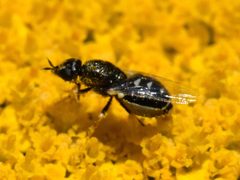
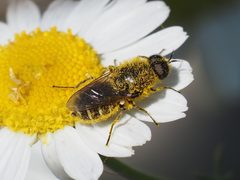
Nemotelinae is a of soldier flies ( Stratiomyidae) comprising four recognized : Brachycara, Lasiopa, Nemotelus, and Pselaphomyia. These flies are characterized by their distinctive wing venation and are primarily found in temperate regions. The genus Nemotelus is the most -rich and well-known within the subfamily. Members are generally small to medium-sized flies often associated with wetland and grassland .
Pronunciation
How to pronounce Nemotelinae: //nɛˌmoʊtɛˈlaɪniː//
These audio files are automatically generated. While they are not always 100% accurate, they are a good starting point.
Identification
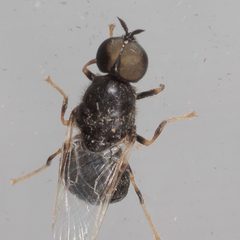
Nemotelinae can be distinguished from other Stratiomyidae by the reduced or modified wing venation, particularly the characteristic arrangement of crossveins and the shape of the . The scutellum typically lacks strong spines. are usually short with a distinct style. in Nemotelus often show pronounced in structure, with males having (contiguous) eyes while females have dichoptic (separated) eyes.
Images
Habitat
Wetlands, marshes, riverbanks, and moist grasslands. Many are associated with riparian zones and areas with standing or slow-moving water where larvae develop.
Distribution
Primarily Holarctic distribution, with greatest diversity in the Palearctic region. Present across Europe, Asia, and North America. Some extend into the Afrotropical and Oriental regions.
Seasonality
are most active during late spring through summer, with peak typically occurring in June–August in temperate regions.
Similar Taxa
- ChloropinaeSimilar small size and coloration, but distinguished by wing venation with reduced anal lobe and different antennal structure; Chloropinae lack the characteristic shape of Nemotelinae.
- BeridinaeBoth occur in similar , but Beridinae possess more robust bodies, longer , and distinctively spined scutellum; wing venation differs in the position of crossvein r-m.
- StratiomyinaeLarger and more robust soldier flies with different wing venation pattern; Stratiomyinae typically have a complete R4+5 loop and more complex color patterns on the body.