
Suillia variegata
(Loew, 1862)
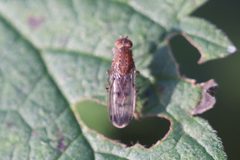
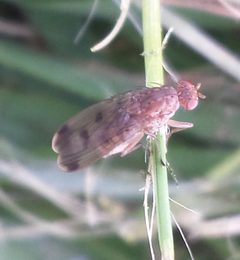
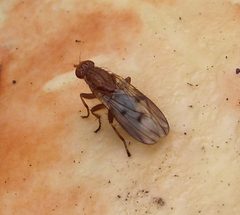
Suillia variegata is a Palearctic of heleomyzid fly distributed throughout Britain and Ireland, with highest occurrence in England and Wales. The species exhibits a mixed feeding strategy, primarily mycophagous but also associated with decaying flowers, roots, and bird's nests. display an earthy brown with sparse hairs and a pale striped , with distinctive wing spines useful for identification. The species peaks in during April/May and July/August.
Pronunciation
How to pronounce Suillia variegata: /ˈswɪliə ˌvɛəriˈeɪɡətə/
These audio files are automatically generated. While they are not always 100% accurate, they are a good starting point.
Identification
Distinguished from similar heleomyzid by the presence of wing spines and the characteristic with red-brown ground colour and specific spicule patterns. The earthy brown with sparse hairs and pale striped provides additional field recognition characters.
Images
Habitat
Shaded areas near fungi and decaying plant matter; present in various but most frequently encountered in association with fungal fruiting bodies and decomposing organic material.
Distribution
Palearctic region; throughout Britain and Ireland with highest occurrence in England and Wales; also recorded from Faial, Flores, Graciosa, São Jorge, and São Miguel (Azores). Specific collection localities include Wytham Woods, Oxfordshire, UK and Natural History Museum Wildlife Garden, UK.
Seasonality
All year round throughout Britain and Ireland; peaks in during April/May and July/August.
Diet
Primarily mycophagous (fungi-feeding); also reared from decaying flowers, roots, and bird's nests. Mixed feeding strategy centered on decaying plant matter.
Behavior
have been collected using beer traps, indicating attraction to fermented substrates.
More Details
Genome Sequencing
- assembly of 264.0 Mb with 7 chromosomal pseudomolecules (5 plus X and Y ) and a 16.17 kb mitochondrial genome, sequenced from a male collected in Wytham Woods, Oxfordshire, UK.
Sources and further reading
- BugGuide
- Wikipedia
- GBIF taxonomy match
- iNaturalist taxon
- NCBI Taxonomy
- Catalogue of Life
- Limb Regeneration in Lady Beetles: Product of Selection or Developmental Byproduct?
- Friday Flower – Ceibo | Beetles In The Bush
- How many non-native flatworms are in your garden...? - Buglife Blog - Buglife
- Winter Botany Quiz #6 – answers and a checklist | Beetles In The Bush
- April | 2010 | Beetles In The Bush | Page 2
- Saldidae | Beetles In The Bush
- The genome sequence of a heleomyzid fly, Suillia variegata (Loew, 1862).