
Sepedon americana
Steyskal, 1951
American snail-killing fly
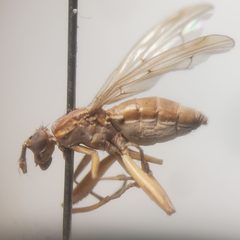
Sepedon americana is a of marsh fly in the Sciomyzidae, commonly known as snail-killing flies. The species was described by Steyskal in 1951. Like all members of the Sepedon, its larvae are obligate of aquatic pulmonate snails. The species occurs in North America and has been documented in regions including Colorado. are active early in the year, with observations in February recorded.
Pronunciation
How to pronounce Sepedon americana: /sɛˈpiːdɒn əˌmɛɹɪˈkɑːnə/
These audio files are automatically generated. While they are not always 100% accurate, they are a good starting point.
Identification
Sepedon americana can be distinguished from other North American Sepedon using morphological keys. The Sepedon contains 20 recognized species in North America, arranged into species groups based on shared characteristics. Identification to species level requires examination of specific morphological traits detailed in taxonomic keys. Males can be recognized by their modified hind legs with bowed tibiae and swollen, toothed .
Images
Habitat
Aquatic and semi-aquatic environments including swampy areas, pond margins, stream and river banks, and drainage ditches. need not have permanently flowing water. are associated with emergent vegetation where females deposit .
Distribution
North America. Documented from Colorado and other regions. The is part of a with broad distribution across the continent.
Seasonality
are active in early spring, with confirmed observations in February. Adults overwinter, enabling early-season activity.
Diet
Larvae are obligate of aquatic pulmonate snails, specifically air-breathing mollusks lacking an . Larvae consume 8–50 snails individually during development, with smaller snails taken by early instars and larger snails by third-instar larvae. diet is not documented.
Life Cycle
Females deposit small numbers of in masses on emergent vegetation. Larvae pass through three instars, all predatory on aquatic snails. Larvae live just beneath the water surface, suspended by water- hairs surrounding . Mature larvae pupate in a capsule-like, boat-shaped that floats among organic matter at water margins. emerge from and overwinter.
Behavior
Larvae hunt snails by attacking those without an , avoiding the defensive plate that seals other snail . Larvae risk suffocation from snail mucous and entanglement of respiratory hairs in snail during attacks. Males use modified hind legs to embrace females during courtship and mating.
Ecological Role
of aquatic snails. Potential biocontrol agent for snail intermediate of schistosomes and livestock liver flukes, though field trials have yielded mixed results. Part of aquatic in freshwater .
Human Relevance
Investigated as a potential agent for aquatic snails that human (schistosomes) and livestock liver flukes. The has been studied in laboratory and limited field trials for this application.
Similar Taxa
- Sepedon scapularisAnother North American Sepedon with similar larval and ; distinguished by specific morphological traits in taxonomic keys.
- Other Sepedon speciesTwenty occur in North America, requiring careful morphological examination for differentiation; species groups defined by shared characteristics aid identification.
More Details
Taxonomic Context
Sepedon americana was described by Steyskal in 1951. The Sepedon is classified in the Sciomyzidae (marsh flies), a group specialized for on aquatic mollusks.
Research Significance
The has been included in studies evaluating Sciomyzidae as biocontrol agents for medically and veterinary important snails, contributing to understanding of -prey dynamics in freshwater systems.
Sources and further reading
- BugGuide
- GBIF taxonomy match
- iNaturalist taxon
- Catalogue of Life
- Bug Eric: Snail-killing Flies, genus Sepedon
- Deerly departed: food for flesh-recycling carrion beetles - Margined carrion beetle, Oiceoptoma noveboracense, and American carrion beetle, Necrophila americana — Bug of the Week
- Unwelcome guests in Hawai’i: American cockroach, Periplaneta americana, German cockroach, Blattella germanica, and Western yellowjacket, Vespula pensylvanica — Bug of the Week
- As a Watershed is Urbanized, Damselflies Show Declines
- Silphidae | Beetles In The Bush
- Explorer or Wallflower? Study Shines Light on Cockroach Personalities