
Bibiocephala
Osten Sacken, 1874
net-winged midges
Species Guides
1Bibiocephala is a of net-winged midges in the Blephariceridae, established by Osten Sacken in 1874. The genus contains five described distributed across the Holarctic region. These are members of a specialized family whose larvae inhabit fast-flowing streams and rivers. Bibiocephala are characterized by their distinctive wing venation with dense, net-like crossveins that give the family its .
Pronunciation
How to pronounce Bibiocephala: /ˌbɪbi.oʊˈsɛfələ/
These audio files are automatically generated. While they are not always 100% accurate, they are a good starting point.
Identification
The combination of net-veined wings and placement in Blephariceridae distinguishes Bibiocephala from all other Diptera . Within Blephariceridae, identification relies on wing pattern details, body size, and degree of wing infuscation. B. minor is distinguished by its small size; B. grandis and B. maxima by their larger stature; B. infuscata by its notably darkened wings. Geographic distribution provides additional diagnostic context.
Images
Appearance
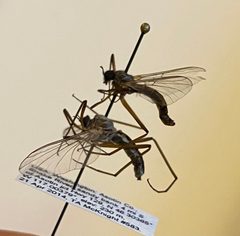
possess broad wings with dense, reticulate venation forming a net-like pattern, a diagnostic feature of Blephariceridae. The wing is typically darkened or infuscated in many . Body size varies among species, with B. grandis and B. maxima being relatively large and B. minor notably smaller. The is relatively broad, consistent with the name (from Latin 'bibio' = and 'cephala' = head). are short to medium in length. Legs are slender and relatively long.
Habitat
Larval stages inhabit torrenticolous environments—fast-flowing, well-oxygenated streams and rivers with rocky substrates. are typically found in riparian zones near larval . Specific microhabitat preferences for individual remain poorly documented.
Distribution
Holarctic distribution encompassing North America (B. grandis), Europe and northern Asia (B. maxima, B. minor), and East Asia including Japan (B. infuscata, B. komaensis, B. minor). The spans temperate to regions.
Life Cycle
Holometabolous development with aquatic larval stages. Larvae are specialized for life in torrential waters, possessing suckers for attachment to rocks in fast currents. Specific details of , larval instars, pupal , and patterns are not documented for this .
Behavior
have been observed near streams, presumably engaging in mating and oviposition activities. Larval involves attachment to submerged stones in currents using sucking discs, a -wide for torrenticolous life.
Ecological Role
Larvae function as primary consumers in lotic , feeding on periphyton and organic matter on submerged rocks. They contribute to nutrient cycling in fast-flowing stream . pressure and specific trophic relationships are undocumented.
Human Relevance
No direct economic or medical importance. The is of interest to aquatic entomologists and biomonitoring programs due to its association with high-quality, oxygen-rich stream . Presence indicates minimally disturbed lotic .
Similar Taxa
- BlephariceraThe other major Holarctic of Blephariceridae; distinguished by wing venation details and genitalic characters requiring microscopic examination.
- HapalothrixAnother blepharicerid ; Bibiocephala are generally larger with more extensively net-veined wings.
More Details
Taxonomic history
The was established by Osten Sacken in 1874 with B. grandis as type . Asian species were described primarily by Japanese entomologists Kitakami and Matsumura in the early-to-mid 20th century.
Conservation relevance
As torrenticolous , Bibiocephala are sensitive to stream degradation, siltation, and flow alteration. They may serve as indicator for river health assessments, though specific monitoring protocols have not been developed.