
Ophiomyia camarae
Spencer, 1963
Herring-bone Leafminer, Herringbone Leaf-miner
Ophiomyia camarae is a small leaf-mining fly (1.5–2 mm) native to the Caribbean, Mexico, Central America, and Florida. It has been introduced to multiple countries outside the Americas as a agent for the weed camara. The exhibits strong specificity, with larvae mining the leaves of Lantana species. are distinguished by their shiny black bodies and red .
Pronunciation
How to pronounce Ophiomyia camarae: /oʊˈfaɪəˌmaɪə kəˈmɑːri/
These audio files are automatically generated. While they are not always 100% accurate, they are a good starting point.
Identification
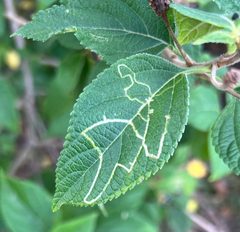
are small (1.5–2 mm), shiny black with distinctive red . Larvae create characteristic leaf mines in foliage. The 'herringbone' pattern of the leaf mines may aid in field identification. Distinguished from other Agromyzidae by association with Lantana and the combination of adult coloration and size.
Images
Habitat
Associated with camara and related Lantana ; occurs in where plants grow, including disturbed areas, rangelands, and natural vegetation invaded by Lantana.
Distribution
Native to the Caribbean, Mexico, Central America, and Florida. Introduced to South Africa (approved for release in 2001), Australia (under investigation), and other countries outside the Americas for . Established confirmed in Swaziland.
Diet
Larvae feed on leaf tissue of camara, creating internal leaf mines. do not feed on plant tissue.
Host Associations
- Lantana camara - primary Main for larval development; strong oviposition preference observed
- Lantana trifolia - secondary Survival to adulthood observed in no-choice tests, but significantly lower than on L. camara
- Lippia species - secondary Four Lippia supported survival to adulthood in no-choice tests, but with reduced
Life Cycle
Larvae develop within leaves of , mining internal tissue. Specific details on , pupal, and longevity not available from sources.
Behavior
Exhibits strong oviposition preference for camara in paired-choice tests. Engages in competitive interactions with other herbivores sharing the same , such as the Uroplata girardi. Leaf-mining larvae remain concealed within host foliage.
Ecological Role
agent for camara. Functions as a herbivore that reduces plant through larval leaf mining. Competes with other Lantana herbivores for host resources.
Human Relevance
Used intentionally as a agent to manage camara, a major weed in tropical and subtropical regions. -specificity testing has demonstrated limited risk to non-target plants, supporting its use in weed management programs.
Similar Taxa
- Other Ophiomyia speciesSame ; distinguished by specificity to and the combination of small size, shiny black body, and red in
- Other Agromyzidae leaf minersSimilar leaf-mining habit; distinguished by the characteristic herringbone mine pattern and exclusive association with
Sources and further reading
- BugGuide
- Wikipedia
- GBIF taxonomy match
- iNaturalist taxon
- NCBI Taxonomy
- Catalogue of Life
- Biology and host range of Ophiomyia camarae, a biological control agent for Lantana camara in South Africa
- Interaction BetweenUroplata girardi(Coleoptera: Chrysomelidae) andOphiomyia camarae(Diptera: Agromyzidae) on a Shared HostLantana camara(Verbenaceae)
- Biology and host range ofOphiomyia camaraeSpencer (Diptera: Agromyzidae), a potential biocontrol agent forLantanaspp. (Verbenaceae) in Australia
- Distribution and abundance of the herringbone leaf-miner,Ophiomyia camarae(Diptera: Agromyzidae) onLantana camara(Verbenaceae) in selected areas of Swaziland