
Tachina
Meigen, 1803
Species Guides
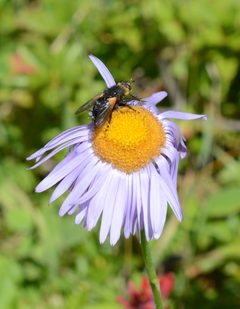
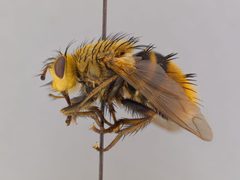
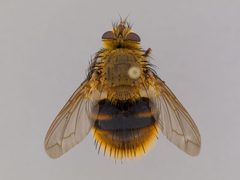
1Tachina is a of large tachinid flies comprising approximately 600 worldwide. are typically 9–14 mm in length with conspicuous spiky bristles. The genus is notable for its larval lifestyle, with most species targeting lepidopteran caterpillars as . Tachina fera, the best-studied species, has a -level assembly representing the first high-quality genomic resource for the Tachinidae.
Pronunciation
How to pronounce Tachina: /ˈtæ.kiː.nə/
These audio files are automatically generated. While they are not always 100% accurate, they are a good starting point.
Identification
Members of Tachina are large, robust tachinid flies with prominent, dense bristle covering (setae) on the body. Tachina fera specifically shows a chestnut-colored with a dark central stripe and spiky bristles. Females are morphologically challenging to identify due to fewer distinct characters compared to males.
Images
Habitat
Found in open countryside, meadows, and woodland edges. Tachina fera is abundant across European countryside and has been specifically recorded from Wytham Woods, Oxfordshire, UK.
Distribution
Worldwide distribution with approximately 600 . Tachina fera occurs across Europe, North Africa, and Asia, with records from the UK (Berkshire), Denmark, Norway, Sweden, and Vermont, USA.
Seasonality
Tachina fera is in the UK, with periods in May–June and July–September.
Diet
feed at flowers throughout the landscape.
Host Associations
- Noctuid moth caterpillars - Larval for Tachina fera
Life Cycle
are laid pre-incubated onto leaves near the rather than being placed directly into the host by the female. Upon hatching, larvae actively seek out host caterpillars, using vibration cues to locate them. Tachina fera is in the UK.
Behavior
Unique strategy where are deposited pre-incubated on vegetation near potential ; newly hatched larvae are mobile and use vibration stimuli to actively locate and penetrate host caterpillars.
Ecological Role
Important regulator of insect herbivory through of caterpillars. contribute to pollination through flower feeding.
Similar Taxa
- NowickiaFormerly treated as a subgenus of Tachina by some authors, but now accepted as a valid separate following most current taxonomic treatments.
More Details
Genomic resources
Tachina fera has a -level assembly of 752 Mb with 12,253 protein-coding genes, representing the first high-quality genome for the Tachinidae.
Taxonomic history
The Nowickia was historically treated as a subgenus of Tachina but is now accepted as a valid genus and treated separately.
Identification challenges
Morphological identification of female Tachinidae is notably difficult due to reduced distinct morphological characters compared to males.
Sources and further reading
- BugGuide
- Wikipedia
- GBIF taxonomy match
- NCBI Taxonomy
- Catalogue of Life
- Encyrtid Holdings | Entomology Research Museum
- The genome sequence of Tachina fera (Linnaeus, 1761), a tachinid fly.
- Identification of BOLD engine deficiencies and suggestions for improvement based on a curated Tachina (Diptera) record set.