
Ormia punctata
Robineau-Desvoidy, 1830
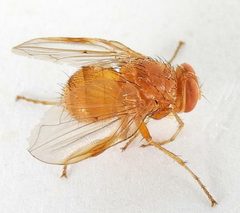
Ormia punctata is a tachinid fly in the tribe Ormiini, first described by Robineau-Desvoidy in 1830. The belongs to a notable for its specialized lifestyle targeting crickets and katydids. Ormiine flies possess a distinctive hearing organ adapted for locating their singing . The species has been recorded from North America, though detailed biological information remains limited.
Pronunciation
How to pronounce Ormia punctata: /ˈɔr.mi.a pʊŋkˈtaː.ta/
These audio files are automatically generated. While they are not always 100% accurate, they are a good starting point.
Identification
Ormia punctata can be distinguished from other Ormia by the presence of distinct punctation on the body, as indicated by its specific epithet. Members of the Ormia are recognized by their small, compact body form and the presence of a tympanal organ (hearing organ) on the , a unique among tachinid flies for detecting calling songs. Accurate species-level identification within Ormia typically requires examination of genitalia and detailed chaetotaxy.
Images
Distribution
North America. Distribution records indicate presence on the continent, though specific range details are not well documented.
Host Associations
- Gryllidae (crickets) - Ormiine tachinids are known to parasitize crickets and katydids; specific records for O. punctata are not documented
- Tettigoniidae (katydids) - -level association; specific host records for O. punctata are not documented
Behavior
Ecological Role
As a of orthopteran insects, Ormia punctata likely contributes to of and . The Ormia represents a notable example of acoustic in insects.
Similar Taxa
- Other Ormia speciesOrmia contains multiple with similar and ; O. punctata is distinguished by punctate body and specific genitalic characters
- Other Ormiini genera (e.g., Homotrixa, Therobia)Share the lifestyle on Orthoptera and prosternal tympanal organs; differ in body form, chaetotaxy, and details of the hearing organ structure
More Details
Acoustic parasitism
Ormia punctata belongs to a tribe of flies that have evolved remarkable convergent adaptations for locating by sound. The tympanal organ in Ormiini represents one of the most sensitive known insect ears, capable of detecting and localizing the faint calling songs of crickets from considerable distances. This sensory allows females to deposit larvae directly on or near singing males.
Taxonomic note
The specific epithet 'punctata' refers to the punctate (dotted or pitted) surface sculpturing characteristic of this . The Ormia was established by Robineau-Desvoidy in 1830, the same year this species was described.