
Triarthria
Stephens, 1829
Species Guides
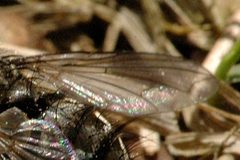
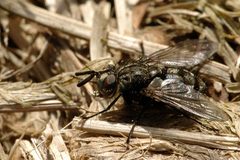
1- Triarthria setipennis(European earwig parasitoid fly)
Triarthria is a of tachinid flies (Diptera: Tachinidae) comprising four recognized . Two species occur in the New World: T. setipennis, introduced from Europe as a agent for the European earwig, and T. parva, a widespread of Doru spp. in the Neotropical region. The genus is characterized by parasitoid associations with earwigs (Dermaptera).
Pronunciation
How to pronounce Triarthria: //traɪˈɑrθriə//
These audio files are automatically generated. While they are not always 100% accurate, they are a good starting point.
Identification
The Triarthria can be distinguished from other Tachinidae by its specific association with and morphological features detailed in genus-level . A key to the four (T. legeri, T. tienshanensis, T. setipennis, and T. parva) is available. T. setipennis and T. parva in the New World have been specifically diagnosed and illustrated.
Images
Distribution
Native to the Palearctic region: T. legeri in the western Palearctic, T. tienshanensis in Uzbekistan, and T. setipennis in Europe. T. setipennis has been introduced and established in North America (British Columbia and Newfoundland, Canada). T. parva is widespread in the Neotropical region. GBIF records indicate presence in Denmark, Norway, and Sweden.
Host Associations
- Forficula auricularia - European earwig; of T. setipennis
- Doru spp. - Earwigs; of T. parva in Neotropical region
Ecological Role
of earwigs (Dermaptera). T. setipennis has been introduced as a agent for the European earwig, with observed rates up to 46.9% in field conditions.
Human Relevance
T. setipennis has been intentionally introduced from Europe to North America for of the European earwig, an established pest . It provides low levels of control in Canada. Research has investigated selection to improve efficacy.
Similar Taxa
- Ocytata pallipesAlso a tachinid of the European earwig; studied alongside T. setipennis for biocontrol potential
- ParkerellaFormerly a now synonymized under Triarthria; T. parva was originally described as Parkerella parva
More Details
Taxonomic History
The Parkerella Townsend has been synonymized under Triarthria, with T. parva transferred as a new combination (comb. nov.).
Reproductive Biology of T. setipennis
Specific microclimatic conditions and sufficient territorial space are required to elicit mating activity. Older males mate readily with newly emerged females. Females are ovolarviparous, laying an average of 235 over 4–5 days close to potential .
Larval Development of T. setipennis
First-instar larvae contact , mount them, and attempt penetration through intersegmental within 3 minutes; only 16.7% successfully penetrate. Larval development lasts 2 weeks to 2 months. occurs in the pupal stage. One complete and one partial occur annually in Germany and northwestern Switzerland.
Sources and further reading
- BugGuide
- Wikipedia
- GBIF taxonomy match
- iNaturalist taxon
- NCBI Taxonomy
- Catalogue of Life
- EARWIG PARASITOIDS OF THE GENUSTRIARTHRIASTEPHENS (DIPTERA: TACHINIDAE) IN THE NEW WORLD
- BIOLOGY OF TRIARTHRIA SETIPENNIS (FALLÉN) (DIPTERA: TACHINIDAE), A NATIVE PARASITOID OF THE EUROPEAN EARWIG, FORFICULA AURICULARIA L. (DERMAPTERA: FORFICULIDAE), IN EUROPE
- Biology and host range testing of Triarthria setipennis and Ocytata pallipes (Diptera: Tachinidae) for the control of the European earwig (Forficula auricularia)