
Gymnosoma
Meigen, 1803
ladybird flies, bug-killer flies
Species Guides
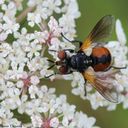
2Gymnosoma is a of tachinid flies (Diptera: Tachinidae) commonly known as ladybird flies or -killer flies. are small , typically 5–6 mm, with distinctive rounded often colored red or orange with dark markings, resembling lady beetles. Larvae develop as internal parasitoids of true bugs (Hemiptera), particularly shieldbugs (Pentatomidae). The genus has been taxonomically challenging; genomic analysis suggests many Palearctic species may represent a single highly variable species rather than distinct . visit flowers for nectar.
Pronunciation
How to pronounce Gymnosoma: /dʒɪmˈnɔsəmə/
These audio files are automatically generated. While they are not always 100% accurate, they are a good starting point.
Identification
Distinguished from other tachinid by the rounded, lady beetle-like with reduced bristling. Separated from true lady beetles (Coccinellidae) by single pair of wings (Diptera), large , and short . Within Tachinidae, the less bristly body and compact form help distinguish Gymnosoma from more setose genera. -level identification is problematic; many Palearctic species are morphologically similar and may not be genetically distinct.
Images
Appearance
Small flies, 5–6 mm in length, with compact, globular bodies. typically red or orange with dark midline markings, superficially resembling lady beetles (Coccinellidae). dark with golden dusting in males. Body less conspicuously bristly than most tachinid flies, reflecting the name (Greek: gymnos = naked, soma = body). bear three main types: basiconica (olfactory, most abundant), chaetica, and coeloconica (mechanosensory/thermohygroreceptory).
Habitat
Warm, dry sites including grasslands. frequent open, shallow flowers such as Hogweed (Heracleum sphondylium), Yarrow (Achillea millefolium), and Mayweeds (Tripleurospermum spp.).
Distribution
Palearctic region with records from Europe (Britain, Ireland, Scandinavia, continental Europe), Asia (Iran, India, Japan), and North America (Vermont, USA). In Britain, historically restricted to southern England but expanding northward and eastward; recent records from East Anglia and Ireland.
Seasonality
active from late April to early October, with peak abundance in August.
Host Associations
- Pentatomidae (shieldbugs) - Primary ; includes Plautia stali, Plautia crossota stali, Palomena spp.
- Lygaeidae (seed bugs) - Referenced in literature
Life Cycle
Holometabolous. deposited on or near . Larvae penetrate host and develop internally as endoparasitoids. Larvae construct cone-type respiratory funnels at apertures opened on host integument or ; funnels formed from tube-shaped faeces wrapped with , independent of host immune response. Secretory glands around larval anal plate likely involved in funnel formation. occurs after host death.
Behavior
respond to of (e.g., Plautia stali), using olfactory cues to locate hosts. Larvae actively construct respiratory structures for while inhabiting host bodies.
Ecological Role
agent of pest stink bugs and shieldbugs. of phytophagous Hemiptera.
Human Relevance
Potential biocontrol agent for agricultural pests, particularly stink bugs. Subject of taxonomic research due to delimitation challenges. sequenced for G. rotundatum (779 Mb, chromosomal-level assembly).
Similar Taxa
- Coccinellidae (lady beetles)Similar rounded, colorful ; distinguished by two pairs of wings in beetles versus one pair in flies, plus antennal and structure
- Other Tachinidae (e.g., Phasiinae, Dexiinae)Share cone-type respiratory funnel formation mechanism; distinguished by body shape and bristle
Misconceptions
The "ladybird fly" leads to confusion with lady beetles (Coccinellidae), which are beetles (Coleoptera), not flies. The name refers to reduced body bristles, not complete hairlessness.
More Details
Taxonomic Uncertainty
Genomic analysis of 11,427 loci and 65,825 SNPs failed to differentiate many currently valid Palearctic , suggesting the may contain fewer species than currently recognized, with G. rotundatum possibly representing a single widespread, variable species.
Respiratory Funnel Evolution
Cone-type funnel formation from larval faeces represents an evolutionary innovation independent of immune manipulation, shared with Phasiinae and Dexiinae , with phylogenetic implications for Tachinidae.
Sources and further reading
- BugGuide
- Wikipedia
- GBIF taxonomy match
- NCBI Taxonomy
- Catalogue of Life
- Bug Squad
- Now That's a Fly! | Bug Squad
- The genome sequence of Gymnosoma rotundatum (Linnaeus, 1758), a parasitoid ladybird fly
- Morphology and distribution of antennal sensilla in a parasitoid fly, Gymnosoma rotundatum (Diptera: Tachinidae)
- The bug-killer fly Gymnosoma rotundatum (L.) (Diptera: Tachinidae) forms the respiratory funnel independently of the host's immune response
- The thin red line between species – genomic differentiation of Gymnosoma Meigen, a taxonomically challenging genus of parasitoid flies (Diptera: Tachinidae)
- Development of a tachinid parasitoid, Gymnosoma rotundatum (Diptera: Tachinidae) on Plautia crossota stali (Heteroptera: Pentatomidae), and its effects on host reproduction
- Peer Review Report For: The genome sequence of Gymnosoma rotundatum (Linnaeus, 1758), a parasitoid ladybird fly [version 1; peer review: 2 approved]
- Peer Review Report For: The genome sequence of Gymnosoma rotundatum (Linnaeus, 1758), a parasitoid ladybird fly [version 1; peer review: 2 approved]
- Response of a parasitoid fly, Gymnosoma rotundatum (Linnaeus) (Diptera: Tachinidae) to the aggregation pheromone of Plautia stali Scott (Hemiptera: Pentatomidae) and its parasitism of hosts under field conditions
- Attraction of a synthetic aggregation pheromone of the brown-winged green bug, Plautia crossota stali Scott to its parasitoids, Gymnosoma rotundata and Trissolcus plautiae.
- Characterization of the complete mitochondrial genome of Gymnosoma dolycoridis (Diptera, Tachinidae) and phylogenetic analysis.