
Winthemia
Robineau-Desvoidy, 1830
Species Guides
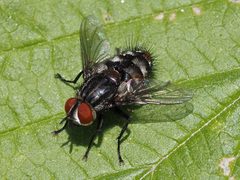
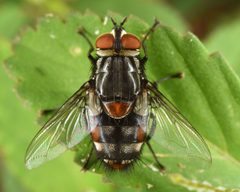
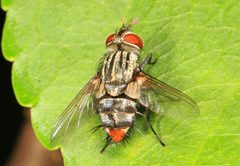
4Winthemia is a of tachinid flies (Diptera: Tachinidae) comprising over 100 described distributed worldwide. Species in this genus are of Lepidoptera, with larvae developing internally in caterpillars. Several species have been studied as agents of agricultural pests, including W. rufopicta on Heliothis species, W. fumiferanae on spruce budworm, and W. manducae on tobacco hornworm. The genus exhibits protandry in and shows complex interactions with host .
Pronunciation
How to pronounce Winthemia: //wɪnˈθɛm.i.ə//
These audio files are automatically generated. While they are not always 100% accurate, they are a good starting point.
Images
Distribution
Winthemia have been recorded across multiple continents including North America, South America, Europe, Asia, and Africa. GBIF distribution records confirm presence in Denmark, Norway, and Sweden. Individual species show varying geographic ranges: W. rufopicta occurs in North America, W. fumiferanae in North America (Quebec), W. citheroniae in regions where large saturniid occur, and W. sumatrensis in South Asia (South Karnataka, India).
Seasonality
Winthemia rufopicta shows beginning in April in North Carolina, with males preceding females by approximately one week. Winthemia fumiferanae exhibits adult emergence synchronized with second to fifth instar spruce budworm larvae, with oviposition peaking when sixth-instar are abundant. Multiple overlapping occur through the growing season, with declining in spring due to host shortage and building through summer and fall.
Diet
Winthemia have been observed feeding on nectar and honeydew. Larvae are obligate endoparasitoids, feeding internally on tissues.
Life Cycle
are deposited on the exterior of caterpillars. First instar larvae enter the host and develop internally, feeding on host tissues. Mature larvae exit the host to pupate in the soil, typically in shallow between 0 and 40 mm below the surface. Winthemia rufopicta overwinters as fully grown diapausing maggots in soil cells. Winthemia fumiferanae shows egg hatching triggered by host . Development rates are temperature-dependent, with egg and larval development times varying with thermal conditions.
Behavior
of some are and active during daylight hours. Females exhibit -searching , orienting to host plants and investigating potential hosts. Winthemia fumiferanae shows protandry, with males emerging before females. Females emerge with undeveloped ovaries and abundant fat reserves; maturation completes within approximately two weeks after . Oviposition behavior includes preference for larger host larvae and selection of host feeding stage based on host plant and larval concealment.
Ecological Role
Winthemia function as larval of Lepidoptera, contributing to of species. Several species are significant mortality agents of agricultural and forestry pests, including spruce budworm, tobacco hornworm, and Heliothis species. The represents part of the diverse tachinid parasitoid complex that helps maintain herbivore balance in natural and managed .
Human Relevance
Several Winthemia have been investigated for of agricultural and forestry pests. Winthemia rufopicta has been studied as a of Heliothis zea and H. virescens on tobacco. Winthemia fumiferanae is a parasitoid of spruce budworm, a major defoliator of spruce-fir forests. Winthemia manducae parasitizes the tobacco hornworm, an agricultural pest of tobacco and tomato.
Sources and further reading
- BugGuide
- Wikipedia
- GBIF taxonomy match
- iNaturalist taxon
- NCBI Taxonomy
- Catalogue of Life
- Bug Eric: White-lined Sphinx ("Hummingbird Moth")
- Biology of the Tachinid Winthemia Datanæ Tns
- Notes on the Biology of Sturmia incompta (Van Der Wulp) and Winthemia citheroniae Sabrosky (Diptera: Larvaevoridae)
- Life History of Winthemia manducae (Diptera: Tachinidae), a Parasite of the Tobacco Hornworm1
- Seasonal Abundance and Natural Mortality of Winthemia manducae (Diptera: Tachinidae) and Degree of Parasitization of Its Host, the Tobacco Hornworm1
- Life History Phenomena of Rogas nolophanae1 and Winthemia sinuata,2 Parasites of the Green Cloverworm3,4
- FACTORS DETERMINING LEVELS OF PARASITISM BY WINTHEMIA RUFOPICTA (DIPTERA: TACHINIDAE), WITH PARTICULAR REFERENCE TO HELIOTHIS SPP. (LEPIDOPTERA: NOCTUIDAE) AS HOSTS
- TEMPERATURE-DEPENDENT DEVELOPMENT OF EGGS AND LARVAE OFWINTHEMIA FUMIFERANAETOTH. (DIPTERA: TACHINIDAE), A LARVAL–PUPAL PARASITOID OF THE SPRUCE BUDWORM (LEPIDOPTERA: TORTRICIDAE)
- SEASONAL CYCLE AND BIOLOGY OF WINTHEMIA RUFOPICTA (DIPTERA: TACHINIDAE) AS A PARASITE OF HELIOTHIS SPP. (LEPIDOPTERA: NOCTUIDAE) ON TOBACCO IN NORTH CAROLINA
- First Host Record for Winthemia analis (Macquart) (Diptera: Tachinidae: Exoristinae) in Brazil: Brassolis sophorae laurentii Stichel (Lepidoptera: Nymphalidae: Brassolinae)
- Seasonal biology of Winthemia fumiferanae Toth. (Diptera: Tachinidae), a larval–pupal parasitoid of the spruce budworm (Lepidoptera: Tortricidae)
- Population dynamics and new record of larval parasitoids, Senometopia sp. and Winthemia sumatrensis (Townsend) (Diptera: Tachinidae) on banana skipper, Erionota torus Evans (Lepidoptera: Hesperiidae) from South Karnataka