
Myiopharus doryphorae
(Riley, 1869)
Myiopharus doryphorae is a tachinid fly native to North America and a specialized of the Colorado potato beetle (Leptinotarsa decemlineata). It develops internally within larvae, with rates reaching 45–67% during peak season. The has been extensively studied for applications against this major agricultural pest.
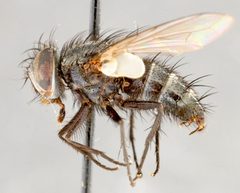
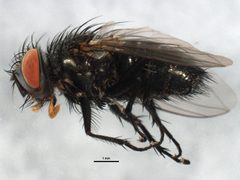
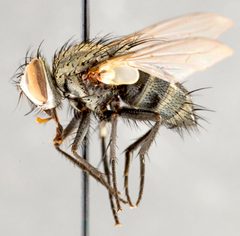
Pronunciation
How to pronounce Myiopharus doryphorae: /ˌmaɪ.oʊˈfɛərəs ˌdɔːrɪˈfɒriː/
These audio files are automatically generated. While they are not always 100% accurate, they are a good starting point.
Identification
As a tachinid fly, likely exhibit typical characteristics including a single pair of functional wings, reduced hindwings (), and bristly body. Specific diagnostic features distinguishing M. doryphorae from such as M. aberrans require examination of adult ; both share the Colorado potato beetle as . Accurate identification typically requires rearing from confirmed host specimens or taxonomic analysis.
Images
Habitat
Agricultural potato fields and areas supporting wild Solanaceae, particularly where the plant Solanum sarrachoides occurs. Distribution closely tracks that of its host , Leptinotarsa decemlineata.
Distribution
Native to North America. Range extends from British Columbia and Nova Scotia in the north to Arizona, Mexico, and South Carolina in the south.
Seasonality
Active during the growing season of its . rates peak in June (67% average), decline through July (58%) and August (45%) based on four-year study data. Pattern varies annually; 1986 showed atypical low June rates with slight August increase.
Host Associations
- Leptinotarsa decemlineata - primary (larval )Colorado potato beetle; occurs in successive larval stages of
- Solanum tuberosum - plant of hostcultivated potato
- Solanum sarrachoides - plant of hostwild plant; rates on beetles from this plant vary annually relative to potato
Life Cycle
Development occurs entirely within larvae. Temperature-dependent development rate documented at constant 15–30°C, with faster development at higher temperatures. Final larval stage occurs underground inside host or nymphs. Overwinters as larva within host remains.
Behavior
Females parasitize Colorado potato beetle larvae in successive instars. rates show seasonal and -plant dependent variation. Recruitment patterns can be used to estimate total parasitism losses in host .
Ecological Role
Major native agent of Colorado potato beetle in North America. Contributes significantly to mortality, with documented rates of 45–67% seasonally. Functions as a relatively host-specific within agroecosystems.
Human Relevance
Studied extensively for of Colorado potato beetle, a severe pest of potato crops. High rates and specificity make it a candidate for and augmentative release programs.
Similar Taxa
- Myiopharus aberrans sharing same (Colorado potato beetle) and similar ; both co-occur and have been studied together. Accurate separation requires morphological examination.
More Details
Taxonomic History
Formerly classified as Doryphorophaga doryphorae; transferred to Myiopharus based on revised tachinid .
Parasitism Variability
plant effects on rates vary annually. During 1983–1984, rates were higher on beetles from potato than from Solanum sarrachoides; this pattern reversed in 1985, indicating complex interactions between , host, and host plant quality.
Sources and further reading
- BugGuide
- Wikipedia
- GBIF taxonomy match
- iNaturalist taxon
- NCBI Taxonomy
- Catalogue of Life
- Temperature-Dependent Development Rate of Myiopharus doryphorae (Diptera: Tachinidae) within Its Host, the Colorado Potato Beetle (Coleoptera: Chrysomelidae)
- SEASONAL AND HOST PLANT EFFECTS ON PARASITISM OF COLORADO POTATO BEETLE BY MYIOPHARUS DORYPHORAE (RILEY) (DIPTERA: TACHINIDAE)
- Direct Measurement of Host and Parasitoid Recruitment for Assessment of Total Losses Due to Parasitism in the Colorado Potato Beetle Leptinotarsa decemlineata (Say) (Coleoptera: Chrysomelidae) and Myiopharus doryphorae (Riley) (Diptera: Tachinidae)
- Behavioral ecology ofMyiopharus doryphorae (riley) andM. aberrans (townsend), tachinid parasitoids of the colorado potato beetle
- Overwintering biology ofMyiopharus aberrans andMyiopharus doryphorae (Dipt.: Tachinidae) larval parasitoids of the colorado potato beetle (Col.: Chrysomelidae)