
Cryptomeigenia
Brauer & Bergenstamm, 1891
Species Guides
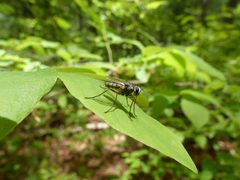
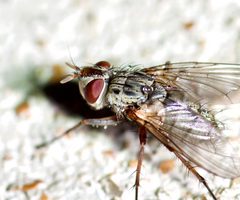
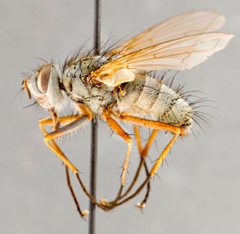
3Cryptomeigenia is a of tachinid flies comprising 17 described . Members are of scarab beetles, with documented specificity to Phyllophaga rufotestacea in at least one studied . The genus was established by Brauer & Bergenstamm in 1891 and is classified within the tribe Blondeliini.
Pronunciation
How to pronounce Cryptomeigenia: //ˌkrɪptoʊmaɪˈdʒiːniə//
These audio files are automatically generated. While they are not always 100% accurate, they are a good starting point.
Identification
Distinguished from other Blondeliini by genitalic characters and specific combinations of bristle patterns; -level identification requires examination of male terminalia and facial coloration patterns. Cryptomeigenia aurifacies is noted for its golden facial coloration.
Images
Habitat
Agricultural plots and wooded areas where scarab beetles occur; documented from southern San Cristóbal de Las Casas, Chiapas, Mexico in association with Phyllophaga rufotestacea.
Distribution
New World distribution; documented from Mexico (Chiapas), with described from across North America including Illinois, Florida, and other regions.
Seasonality
Active during the period of beetles; in Chiapas, observed from June to September, coinciding with .
Host Associations
- Phyllophaga (Phytalus) rufotestacea (Coleoptera: Melolonthidae) - endoparasitoid stage only; -specific at documented site
- Scarabaeidae (adult scarab beetles) - general per -level characterization
Life Cycle
First three phases last 29-32 days under laboratory conditions. Female oviposits 1-45 in abdominal cavity of . Multiple eggs per host, but only one larva survives through and , consuming other eggs and host viscera, causing host death.
Behavior
Endoparasitoid of beetles; exhibits larval where surviving larva consumes and internal tissues. Host-specific to P. rufotestacea at studied site despite presence of 15 other Melolonthidae .
Ecological Role
agent regulating of scarab beetles; rates of 25-27% in male and 16% in female hosts documented in one population.
Human Relevance
Potential biocontrol agent for pest scarab beetles in agricultural settings; no documented negative impacts to humans.
Similar Taxa
- Other Blondeliini generaSimilar tachinid of beetles; distinguished by genitalic and specific bristle patterns
- Other Tachinidae parasitoids of scarabsMay share ; Cryptomeigenia distinguished by specific abdominal oviposition and larval
More Details
Taxonomic note
The contains 17 described , with C. setifacies (originally described as Setifacies setifacies by Brauer & von Bergenstamm, 1891) as the type species. Several species were described by Curran in 1926 and Reinhard in 1947.
Research gap
Most biological details derive from a single of Cryptomeigenia sp. in Chiapas, Mexico; -level remains undocumented for majority of described species.