
Sarcophaga bullata
Parker, 1916
grey flesh fly
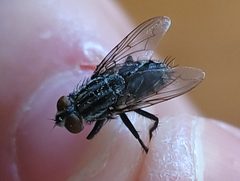
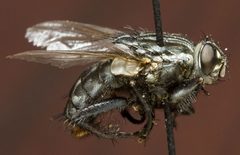
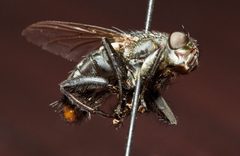
Sarcophaga bullata, commonly known as the grey flesh fly, is a of flesh fly in the Sarcophagidae. range from 8 to 17 millimeters in length and are distinguished by grey coloration with three black longitudinal thoracic stripes and a checkered abdominal pattern. The species is larviparous, giving birth to first-instar larvae rather than laying . It is widely distributed across the Nearctic region and has become increasingly important in for post-mortem interval estimation.
Pronunciation
How to pronounce Sarcophaga bullata: //sɑrˈkɒfəɡə bʊˈleɪtə//
These audio files are automatically generated. While they are not always 100% accurate, they are a good starting point.
Identification
-level identification within Sarcophagidae relies primarily on male genitalia ; external characters are generally insufficient for definitive identification. S. bullata can be distinguished from the similar Sarcophaga haemorrhoidalis by genital examination. -level characters include: only at base (vs. entire length in Calliphoridae); four notopleural bristles (vs. two in Calliphoridae); no postscutellum (present in Tachinidae); and the characteristic thoracic bristle pattern distinguishing it from Muscidae.
Images
Habitat
Found in rural and urban environments, commonly entering houses and indoor dwellings. Associated with decaying organic matter. frequently observed at sap flows on trees, where they feed alongside other insects. In natural settings, found in association with carrion, exposed meat, and excrement.
Distribution
Nearctic region: eastern and southern United States most common, but ranges from the western coast of the United States to Canada. Not naturally distributed outside North America north of Mexico.
Seasonality
Active from May to September, with peak activity in August and September. More frequently encountered indoors during summer months.
Diet
feed on sweet substances including sap, flower nectar, and nectars with high concentrations; females show particular preference for amino acid-rich nectars, likely to support . Larvae feed predominantly on carrion, exposed meat, and excrement.
Life Cycle
Holometabolous development with larviparous : develop internally and females give birth to first-instar larvae directly onto carrion. Larval stages: first instar (0.5–5.0 mm), second instar (4.0–10.0 mm), third instar (9.5–20 mm). Third instar larvae leave carrion to pupate in dry locations. Maternal effect operates that can prevent pupal under certain environmental conditions.
Behavior
are attracted to animal remains in early and late decomposition stages and have been observed flying through extreme weather conditions to reach carrion. Females preferentially aggregate with other carrion flies and larviposit on carcasses that already have larvae present, possibly due to enhanced enzymatic digestion from larval secretions. Males release the hexanal, which attracts females from long distances. Larvae are aggressive competitors that can outcompete and occasionally consume larvae of other .
Ecological Role
Scavenger and decomposer; larvae contribute to breakdown of carrion and organic waste. As a specialized carrion fly, it participates in nutrient cycling. Larval competition can influence of other on carrion.
Human Relevance
Forensically important used for post-mortem interval (PMI) estimation in criminal investigations. Maggots recovered from human remains can be analyzed to estimate time since death. Because females deposit live larvae rather than , forensic calculations must exclude egg development time. The species' maternal effect on and maggot mass temperature effects must be considered for accurate PMI estimation. Lipofuscin accumulation in larvae has been studied as a potential aging technique. Occasionally implicated in myiasis, though primarily associated with dead rather than living tissue.
Similar Taxa
- Sarcophaga haemorrhoidalisVery similar in appearance and ; distinguished by male genitalia .
- Calliphoridae (blow flies)Similar size and carrion association; distinguished by metallic abdominal coloration, entire length, and only two notopleural bristles.
- MuscidaeSimilar overall form; distinguished by thoracic bristle pattern and different abdominal markings.
Misconceptions
The 'flesh fly' implies feed on flesh, but adults actually feed on sweet substances; the flesh-eating habit applies to larvae. masses found on carrion cannot belong to Sarcophagidae due to their larviparous —a common point of confusion in forensic analysis.
More Details
Forensic Significance
S. bullata may be among the first to colonize human remains, particularly in stormy weather when blow flies are less active. Studies have determined specific accumulated degree hours (ADH) and accumulated degree days (ADD) calculations at standardized temperatures for forensic application. Maggot mass temperature effects on development remain under study for improving PMI .
Maternal Effect on Diapause
Research has identified a maternal effect that prevents pupal under short-day conditions unless countered by specific chemical agents (, octopamine, pilocarpine). This has significant implications for forensic timing estimates.
Taxonomic Note
Some classifications place this in the subgenus Neobellieria within Sarcophaga. Species-level identification in Sarcophagidae is notoriously difficult and requires male genitalia examination.
Sources and further reading
- BugGuide
- Wikipedia
- GBIF taxonomy match
- iNaturalist taxon
- NCBI Taxonomy
- Catalogue of Life
- Flies, Maggots and Forensic Entomologists at Bohart Museum on Sunday, July 9 | Bug Squad
- The Flies and Beetles That Turn Death Into Dinner
- Sarcophagidae | Beetles In The Bush
- Super Crop Challenge #4 | Beetles In The Bush