
Oestrus ovis
Linnaeus, 1758
sheep bot fly, sheep nostril fly
Oestrus ovis is an obligate parasitic fly (Diptera: Oestridae) that develops exclusively within the nasal and sinus cavities of sheep and related ungulates. Females are larviparous, depositing live first-instar larvae directly into nostrils during . Larvae develop through three instars within the host before exiting to pupate in soil. The causes oestrosis, a condition marked by nasal discharge, respiratory distress, and reduced productivity in livestock. Human , though uncommon, have been documented worldwide.
Pronunciation
How to pronounce Oestrus ovis: /ˈiːstrəs ˈoʊvɪs/
These audio files are automatically generated. While they are not always 100% accurate, they are a good starting point.
Identification
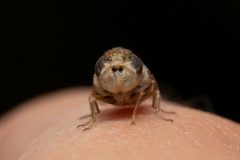
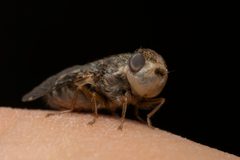
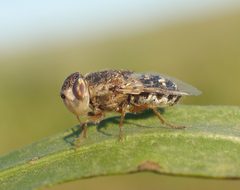
resemble small bees in size and general appearance but can be distinguished by the banded dark grey body pattern and dull yellow . The absence of functional mouthparts separates them from similar-sized muscoid flies. Larvae found in sheep nasal passages are diagnostic: mature larvae reach 20 mm with distinctive dark transverse stripes on each segment. Differentiation from other oestrid flies relies on association and larval within the nasal cavity rather than frontal sinuses or other tissues.
Images
Appearance
are -sized flies measuring 10–12 mm in length. The body is slightly hairy with a banded, dark grey coloration. The and legs are dull yellow. Adults lack functional mouthparts and do not feed. Larvae develop to approximately 20 mm at maturity, with a dark stripe across each segment.
Habitat
Larval development occurs exclusively within the nasal passages, frontal and maxillary cavities, and sinuses of sheep and related ungulates. takes place in soil after larvae exit the . flies are aerial and do not occupy a specific beyond mating near host animals.
Distribution
Widespread globally wherever sheep, goats, and deer are present. Documented in North America, Central America, Mediterranean region, Middle East, Australia, Brazil, South Africa, and northern Europe (where has declined). Present throughout Brazil including Mato Grosso, Minas Gerais, Federal District, and other states.
Seasonality
Activity patterns vary by climate. In temperate regions, and larviposition occur during warmer months. Larval development within ranges from 25–35 days in warm conditions to up to 10 months in cold climates. Pupal development requires 3–9 weeks depending on temperature.
Diet
do not feed; they may take water but lack functional mouthparts. Larvae feed on tissues and secretions within nasal and sinus cavities.
Host Associations
- Ovis aries - primary definitive Domestic sheep; principal for larval development
- Capra hircus - Domestic goats; documented in Brazil and other regions
- Odocoileus spp. - Deer; commonly reported
- Bos taurus - occasional Cattle; infrequent recorded
- Equus caballus - accidental Horses; rare cases documented
- Canis lupus familiaris - accidental Dogs; rare cases documented
- Homo sapiens - accidental Humans; external ophthalmomyiasis and nasal myiasis recorded worldwide
Life Cycle
Females retain fertilized internally; larvae hatch to first instar (1 mm) within the female's body. Females deposit 20–30+ larvae in mucous droplets directly into nostrils during . First-instar larvae migrate through nasal mucosa to sinuses, molting to second instar. Development continues to third instar, reaching 20 mm. Mature larvae exit through nasal passages, drop to ground, and burrow into soil to pupate. lasts 3–9 weeks. emerge, mate, and live 2–4 weeks without feeding. Total larval development time varies from 25–35 days (warm weather) to 10 months (cold climates). Approximately 95% of first-instar larvae die before pupation.
Behavior
Females exhibit larviparous , depositing live larvae rather than —a rare among flies. Larvae display -dependent survival, with optimal survival (~22.5%) at intermediate densities (~40 larvae per ); survival decreases at low (20 larvae, 10%) and high (80 larvae, 11.2%) densities, suggesting self-regulating . Larvae show increasing resistance to adverse conditions with age. Infected sheep display behavioral avoidance responses to flies, including running, nose-to-ground posture, and circular grouping with noses inward.
Ecological Role
Obligate of domestic and wild ruminants. self-regulation at optimal densities (~40 larvae per ) may represent an evolved mechanism to maximize parasite reproductive potential while minimizing host mortality. No significant role as , decomposer, or prey item documented; do not feed and have brief adult lifespan.
Human Relevance
Major veterinary pest causing oestrosis in sheep, with economic impacts through reduced weight gain, wool production, and animal condition. Severe can cause malnutrition and death. Control relies on anthelmintic drenches with variable efficacy due to reinfestation pressure. Zoonotic significance: causes external ophthalmomyiasis (ocular myiasis) and nasal myiasis in humans, typically in shepherds and others in close contact with sheep. Human cases usually resolve without serious complications but require medical attention.
Similar Taxa
- Hypoderma spp. also are oestrid of ungulates but larvae develop in subcutaneous tissues rather than nasal cavities; have different coloration and pattern
- Gasterophilus spp.Horse bot flies deposit on hair rather than larvipositing in nostrils; larvae develop in gastrointestinal tract
- Other Oestrus speciesGeographic range and specificity differ; O. ovis is the primary affecting sheep globally
More Details
Density-dependent regulation
Experimental studies demonstrate that larval survival is highest at intermediate densities (~40 larvae per ), with higher mortality at both lower and higher densities. This suggests evolved self-regulation that balances reproductive success against host survival.
Larval mortality
Natural mortality of first-instar larvae is extremely high (~95% die before ), with additional mortality in second (63.7%) and third (58.4%) instars during experimental manipulation. This high mortality is apparently compensated by female production of numerous larvae.
Sources and further reading
- BugGuide
- Wikipedia
- GBIF taxonomy match
- iNaturalist taxon
- NCBI Taxonomy
- Catalogue of Life
- UBI Professor Demonstrates 'How to Draw a Bug' at Bohart Museum Open House | Bug Squad
- African Fig Fly Meets Spotted-Wing Drosophila in the U.S.
- Small but Destructive: Hibiscus Mealybug Emerges as Concerning Pest of Florida Fruits, Ornamentals, Some Row Crops
- Who's been sucking on my coleus? Citrus mealybug — Bug of the Week
- The woolly devil: a landmark U.S. plant discovery
- Crapemyrtles are not dreaming of a white Christmas: Crapemyrtle bark scale, Acanthococcus (=Eriococcus) lagerstroemiae — Bug of the Week
- Infestação de rebanho ovino por Oestrus ovis na região de Araxá-MG. Relato de caso Infestation by Oestrus ovis sheep flock in the region Araxá-MG. A case report
- Sheep Bot Fly Oestrus ovis Linnaeus (1761) (Insecta: Diptera: Oestridae)
- REGULARITIES OF LARVAE SURVIVAL OF Oestrus ovis L. IN THE HOST BODY
- Ovis aries (Artiodactyla: Bovidae) e Capra hircus (Artiodactyla: Bovidae) parasitados por Oestrus ovis (Diptera: Oestridae) no Distrito Federal, Brasil
- Oestrus ovis Nasal Myiasis with Pupation in Human Host, Greece, October 2025.
- Perception and management of Oestrus ovis human myiasis by physicians: Exploratory survey in an endemic area (Italy).
- Prevalence and seasonal aspects of parasitism by Oestrus ovis (Diptera: Oestridae) in sheep from Mato Grosso State, Brazil.