
Oestrus
Linnaeus, 1758
bot flies, sheep bot flies
Species Guides
1- Oestrus ovis(sheep bot fly)
Oestrus is a of bot flies in the Oestridae, parasitic on mammals. The best-known , Oestrus ovis, commonly called the sheep , deposits larvae in the nasal cavities of sheep and goats, where they develop and cause respiratory distress. are non-feeding and have reduced mouthparts. The genus has a Holarctic distribution, with records from northern Europe and other temperate regions.
Pronunciation
How to pronounce Oestrus: //ˈiːstrəs//
These audio files are automatically generated. While they are not always 100% accurate, they are a good starting point.
Identification
Distinguished from other oestrid by the combination of: -mimic appearance with dense setae; of sheep and related (O. ovis); with reduced mouthparts; and wing venation with a characteristic bend in R4+5. Differs from Hypoderma () by host association and larval development site (nasal vs. subcutaneous). Differs from Gasterophilus (horse bot flies) by larval deposition method (active larviposition onto host vs. -laying on host hair) and host type.
Images
Appearance
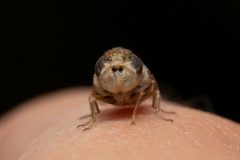
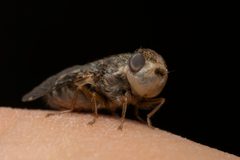
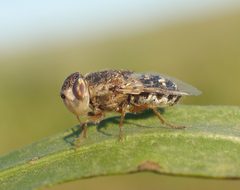
are stout-bodied flies with dense, short hairs covering the body, giving a fuzzy, -like appearance. The is broad with large and reduced or mouthparts. are short and three-segmented. Wings are clear with reduced venation typical of Oestridae. The is relatively short and broad. Coloration is generally dull gray, brown, or black, often with yellowish or whitish markings.
Habitat
are found in open, sunny where animals graze, particularly in mountainous or hilly regions. Larval habitat is within the nasal passages and sinuses of sheep, goats, and occasionally other ungulates. The is associated with pastoral and agricultural landscapes where sheep or goat husbandry occurs.
Distribution
Holarctic distribution. Recorded from northern Europe (Denmark, Norway, Sweden), extending through Mediterranean regions, central Asia, and parts of North America where sheep are present. Distribution follows that of domestic sheep and related .
Seasonality
activity peaks during warm months, typically late spring through summer, varying with latitude and elevation. In temperate regions, adults are most active when temperatures exceed 20°C and conditions are sunny.
Host Associations
- Ovis aries - primary Domestic sheep; larvae develop in nasal cavities and sinuses
- Capra hircus - secondary Domestic goats; less commonly parasitized than sheep
Life Cycle
Females are larviparous, depositing first-instar larvae directly onto the nostrils of during . Larvae migrate to the nasal cavities and frontal sinuses, where they develop through three instars over several months. Third-instar larvae exit the host, drop to the ground, and pupate in soil. emerge from pupae, do not feed, and live only a few days to mate and reproduce.
Behavior
are fast, direct fliers that actively pursue animals. Females exhibit larviparous , ejecting larvae toward the host's nostrils during low . Males patrol host animals and mating sites. Adults are and most active in warm, sunny conditions.
Ecological Role
of domestic and wild sheep and goats. Larval (ovis myiasis) can cause significant respiratory distress, reduced weight gain, and economic losses in livestock. The serves as a model for studying -parasite and myiasis .
Human Relevance
Oestrus ovis is a significant veterinary pest of sheep and goats, causing economic losses through reduced productivity and treatment costs. Rarely, larvae have been known to accidentally infest human or nasal passages, causing temporary but distressing . The is studied in parasitology and veterinary medicine.
Similar Taxa
- HypodermaBoth are oestrid parasitic on ungulates, but Hypoderma () have subcutaneous larval development in cattle and deer, and differ in body shape and larviposition .
- GasterophilusBoth are oestrid bot flies, but Gasterophilus parasitize horses, lay on hair rather than larvipositing, and have distinct with more elongate bodies.
- CephenemyiaBoth are nasal bot flies, but Cephenemyia parasitizes deer and related cervids, and have different antennal structure and body proportions.
More Details
Oestrus ovis research
The Oestrus ovis has been extensively studied as a model for myiasis and - interactions, including research on larval patterns, immune evasion mechanisms, and control methods.
Sources and further reading
- BugGuide
- GBIF taxonomy match
- iNaturalist taxon
- NCBI Taxonomy
- Catalogue of Life
- UBI Professor Demonstrates 'How to Draw a Bug' at Bohart Museum Open House | Bug Squad
- Wednesday “What the heck?” | Beetles In The Bush
- The relationship of age, body weight and factors associated with oestrus to non-return to oestrus of artificially inseminated Merino ewes
- Distribution of P2X receptor subtypes in the rat female reproductive tract at late pro-oestrus/early oestrus
- Effect of short transport during di-oestrus and pro-oestrus on cortisol levels and oestrous behaviour of sheep
- ENHANCEMENT OF OESTRUS DETECTION AND SUCCESS RATE OF ARTIFICIAL INSEMINATION USING SCORE CARD INCORPORATING SECONDARY SIGNS OF OESTRUS IN CROSS BRED DAIRY COWS HAVING REDUCED BEHAVIORAL SIGNS