
Gasterophilus
Leach, 1817
Horse Botflies, Horse Stomach Bot Flies
Species Guides
1- Gasterophilus intestinalis(Horse Bot Fly)
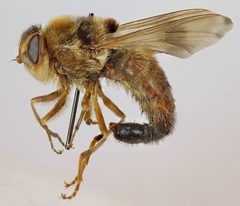
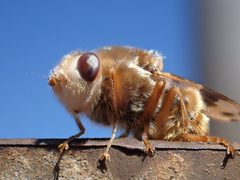
Gasterophilus is a of endoparasitic bot flies in the Oestridae containing nine recognized . are -mimics with yellow and black hairy bodies and brown-patched wings. Larvae develop internally in the gastrointestinal tract of equids and other mammals, causing myiasis. The genus has a worldwide distribution with highest in China and South Africa.
Pronunciation
How to pronounce Gasterophilus: //ɡæˈstɛr.oʊ.fɪˌlʊs//
These audio files are automatically generated. While they are not always 100% accurate, they are a good starting point.
Identification
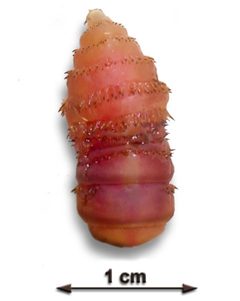
distinguished from other Oestridae by -mimic appearance with yellow-black hair pattern and wing venation. Larvae identified to by: number and arrangement of body spines; presence/absence of two rows of spikes (G. haemorrhoidalis, G. nasalis vs. others); mouthpart curvature (G. intestinalis has non-uniformly curved mouthparts with blunt spine tips); and predilection site in (G. intestinalis in gastric fundus and nonglandular stomach regions; G. nasalis in first duodenal ampulla). identified by placement site on host body and morphological features visible under magnification.
Images
Habitat
occur in open near animals, with mating at hilltop sites. Larval habitat is strictly internal: (tongue, gums) for first instar; stomach (nonglandular regions, margo plicatus, saccus cecus) and duodenum for second and third instars. occurs in soil or substrate contaminated with host .
Distribution
Worldwide distribution. Highest : China and South Africa (7 each); Mongolia, Senegal, and Ukraine (6 species each). Individual species ranges: G. intestinalis and G. haemorrhoidalis—worldwide; G. nasalis—Holarctic origin but worldwide; G. flavipes—Palaearctic and Afrotropical; G. inermis—Old World; G. meridionalis and G. ternicinctus—Afrotropical; G. nigricornis—Middle East to China; G. pecorum—Old World.
Seasonality
activity peaks during summer and fall months. Larvae present in stomachs year-round with seasonal variation: highest average larval burdens in winter and spring; lowest in fall. In Texas, early instars (second and young third) predominate in fall; late third instars predominate in winter, spring, and summer. in spring; adult after 3–10 weeks.
Host Associations
- Equidae (horses, mules, donkeys) - primary G. intestinalis, G. nasalis, G. haemorrhoidalis, G. inermis, G. pecorum, G. nigricornis
- Zebra - G. meridionalis, G. ternicinctus primarily; also G. nasalis, G. pecorum
- Sheep and goats - G. nasalis primarily
- Cattle - occasional G. nasalis rarely
- Reindeer - G. haemorrhoidalis
- Humans - accidental Single recorded case in infant
Life Cycle
Complete with internal parasitic larval development. females oviposit on hair coat during summer-fall. hatch after approximately 7 days, stimulated by host /licking. First instar larvae enter and attach to tongue/gums for 4–6 weeks, causing inflammation. Second instar swallowed; attaches to stomach or duodenal mucosa and matures over 8–9 months, in host. Third instar completes development in spring, detaches, and passes in as . Pupal period 3–10 weeks; adults emerge to repeat cycle. Total time approximately one year.
Behavior
exhibit hilltop for mating: males arrive first (protandry), establish territories, and intercept arriving virgin females. Copulation occurs at aggregation site; males depart after mating, mated females leave to seek for oviposition. Adults are . Larvae exhibit site-specific attachment within host digestive tract, preferring dorsally positioned areas with higher oxygen availability. First instar larvae actively migrate to ; later instars remain attached at fixed sites.
Ecological Role
of large mammals; of generally minimal at typical larval burdens. Larval detachment and in contributes to nutrient cycling. serve as limited due to nectar feeding (mouthparts reduced but functional for liquid uptake).
Human Relevance
Veterinary significance as equine . G. pecorum considered most pathogenic ; large larval burdens can cause gastritis, ulceration, perforation, and colic. Typical burdens (~100 larvae) tolerated without clinical signs; heavy require anthelmintic treatment (trichlorphon, dichlorvos, ivermectin, moxidectin). Management includes removal by scraping/washing legs and shoulders, and environmental control of larval development in manure. Zoonotic potential minimal; single human case recorded. Economic impact through treatment costs and potential performance reduction in working animals.
Similar Taxa
- HypodermaBoth are oestrid bot flies with hypodermic larval development, but Hypoderma () migrate through tissues and have subcutaneous larval stages rather than gastrointestinal development; lack the distinct -mimic coloration.
- CuterebraBoth are oestrid flies with mammalian , but Cuterebra (rodent bot flies) have subcutaneous larval development causing warble formation; are larger with different coloration and lack hilltop mating .
- OestrusBoth are oestrid flies with /respiratory , but Oestrus ovis (sheep nasal bot fly) larvae develop in nasal sinuses rather than gastrointestinal tract; have different and do not exhibit hilltop mating .
- CephenemyiaBoth are oestrid flies parasitic on cervids, but Cephenemyia (deer bot flies) have pharyngeal larval development; are faster fliers with different body proportions and lack the dense yellow-black pile of Gasterophilus.
More Details
Species Diversity
Nine valid recognized following taxonomic revision (Li et al. 2019): G. flavipes, G. haemorrhoidalis, G. inermis, G. intestinalis, G. meridionalis, G. nasalis, G. nigricornis, G. pecorum, and G. ternicinctus.
Oviposition Site Specificity
-specific placement: G. intestinalis on lower legs and shoulders; G. nasalis around mouth, , nose, and chin; other species have characteristic placement patterns used in identification.
Oxygen Requirements
Larval attachment sites in stomach and duodenum are consistently in dorsally positioned areas, suggesting behavioral to exploit higher oxygen availability near the air-mucosa interface.
Sources and further reading
- BugGuide
- Wikipedia
- GBIF taxonomy match
- iNaturalist taxon
- NCBI Taxonomy
- Catalogue of Life
- Wednesday “What the heck?” | Beetles In The Bush
- Seasonal occurrence and distribution of Gasterophilus intestinalis and Gasterophilus nasalis in the stomachs of equids in Texas
- Figure 19 from: Li X-Y, Pape T, Zhang D (2019) Taxonomic review of Gasterophilus (Oestridae, Gasterophilinae) of the world, with updated nomenclature, keys, biological notes, and distributions. ZooKeys 891: 119-156. https://doi.org/10.3897/zookeys.891.38560
- Hilltop Aggregation and Mating Behavior by Gasterophilus Intestinalis (Diptera: Gasterophilidae)1
- Seasonality, control, and risk factors for Gasterophilus intestinalis egg intensity in horses from Romania under field conditions.