
Hypoderma tarandi
(Linnaeus, 1758)
Reindeer Warble Fly, Reindeer Botfly, Caribou Bot Fly
Hypoderma tarandi is a parasitic (Diptera: Oestridae) that infests reindeer and caribou across Arctic and subarctic regions. females lay on hair shafts; larvae penetrate the skin and develop in subcutaneous tissues, creating warble . The has exceptionally strong capacity in females, with maximum lifetime flight distances estimated at 600–900 km, an linked to the migratory of its host. Adults do not feed; they rely entirely on fat reserves accumulated during larval development. The species causes economic damage to hides, meat, and milk production in domesticated herds and has been documented causing ophthalmomyiasis in humans.
Pronunciation
How to pronounce Hypoderma tarandi: //haɪˈpɒdərmə təˈrændi//
These audio files are automatically generated. While they are not always 100% accurate, they are a good starting point.
Identification
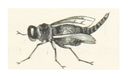
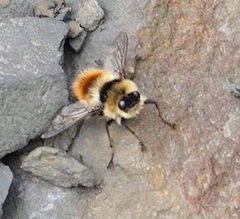
are robust, -mimicking flies with reduced mouthparts and no functional feeding structures. Males are larger than females in most size measures except wing length. Identification from other Hypoderma requires examination of adult ; H. tarandi is distinguished by its specific association with reindeer/caribou . Larvae are skin-penetrating bots that create characteristic warble swellings in host skin.
Images
Habitat
Arctic and subarctic tundra and taiga regions. Mating occurs at specific topographical landmarks: rocky areas along rivers, streams, or drying river/stream beds in treeless vidda (tundra-like biome), and certain areas along dirt road tracks or paths in wooded valleys below the vidda.
Distribution
Circumpolar Arctic and subarctic regions. Present in Norway, Sweden, northern Finland, Russia, Alaska, Canada, and Greenland. Records from the conterminous 48 United States likely represent vagrants or misidentifications.
Seasonality
activity period corresponds to warm summer months when temperatures permit and mating. hatching occurs 3 days to 2 weeks after oviposition depending on temperature, with optimal development between 20–37°C.
Diet
do not feed; they possess non-functional mouthparts and rely entirely on fat reserves accumulated during larval development. Larvae are obligate feeding on tissues within subcutaneous warbles of reindeer and caribou.
Host Associations
- Rangifer tarandus - obligate Larvae develop in subcutaneous tissues; locate using olfactory cues from host volatiles
Life Cycle
are attached to hair shafts near the skin surface. Larvae hatch and penetrate skin, developing through three instars in subcutaneous warbles over approximately one year. Third-instar larvae exit through skin pores and pupate in soil. emerge from pupae with fully developed eggs; females are larviparous with mean egg load of 609 eggs (range 354–772). Adult lifespan is short: 1.2–27 days for H. tarandi under laboratory conditions, with males typically surviving longer than females.
Behavior
Males exhibit pronounced thermoregulatory including substratum selection, body orientation to sun, crouching, stilting, and into cooler air; they cannot metabolically cool at 25–38°C. On warm sunny days, males perch for only 1–2 minutes before flying to cooler air. Males aggressively pursue all Hypoderma-sized objects but do not defend specific perch sites, pursuing and catching females in flight or hopping onto landed females. Copulation lasts 10–19.5 minutes. Females have exceptional flight capacity: maximum total flying time 31.5 hours, longest continuous flight 12 hours, with estimated lifetime maximum flight distance of 600–900 km. Unmated females are reluctant to fly; mating alters flight behavior dramatically.
Ecological Role
of migratory ungulates; are tightly coupled with patterns. The ' extraordinary capacity in females is an evolutionary to track mobile host across vast Arctic landscapes.
Human Relevance
Causes economic losses in reindeer husbandry through hide damage, reduced meat quality, and decreased milk production. Larvae have been consumed as traditional food by Arctic peoples including the Nunamiut and Inuit. Documented cause of ophthalmomyiasis in humans, with potential for uveitis, glaucoma, and retinal detachment. Control attempts using ivermectin have proven difficult due to the ' strong capacity; on islands has failed even after repeated treatments due to immigration from mainland .
Similar Taxa
- Cephenemyia trompeAlso a reindeer (nose bot fly), but larvae develop in nasal cavities rather than subcutaneous tissues. are larviparous rather than , and females are larger than males (opposite pattern to H. tarandi). C. trompe has shorter capacity (maximum 10.8 hours total flight time vs. 31.5 hours for H. tarandi).
- Hypoderma lineatumCattle ; differs in association (Bos taurus) and geographic distribution (temperate regions).
- Hypoderma bovisAnother cattle ; H. tarandi is specific to Rangifer and has evolved greater capacity corresponding to .
Sources and further reading
- BugGuide
- Wikipedia
- GBIF taxonomy match
- iNaturalist taxon
- NCBI Taxonomy
- Surviving winter, Part IV: A Monarch Christmas in Monterey, Danaus plexippus — Bug of the Week
- Catching up with the Monarch butterfly, Danaus plexippus — Bug of the Week
- Monarchs and Mojitos: Monarch butterfly, Danaus plexippus — Bug of the Week
- Wednesday “What the heck?” | Beetles In The Bush
- Mating behavior and thermoregulation of the reindeer warble fly,Hypoderma tarandi L. (Diptera: Oestridae)
- Abiotic factors influencing embryonic development, egg hatching, and larval orientation in the reindeer warble fly, Hypoderma tarandi
- Factors affecting size, longevity and fecundity in the reindeer oestrid flies Hypoderma tarandi (L.) and Cephenemyia trompe (Modeer)
- Failure of two consecutive annual treatments with ivermectin to eradicate the reindeer parasites (Hypoderma tarandi, Cephenemyia trompe and Linguatula arctica) from an island in northern Norway
- The two reindeer parasites,Hypoderma tarandi andCephenemyia trompe (Oestridae), have evolved similar olfactory receptor abilities to volatiles from their common host
- Flight capacity of the reindeer warble fly, Hypoderma tarandi (L.), and the reindeer nose bot fly, Cephenemyia trompe (Modeer) (Diptera: Oestridae)
- Trapping oestrid parasites of reindeer: the relative age, fat body content and gonotrophic conditions of Cephenemyia trompe and Hypoderma tarandi females caught in baited traps
- Dimethyl trisulphide is a strong attractant for some calliphorids and a muscid but not for the reindeer oestrids Hypoderma tarandi and Cephenemyia trompe