
Cynomya
Robineau-Desvoidy, 1830
dog-fly
Species Guides
1- Cynomya cadaverina(Shiny Blue Bottle Fly)
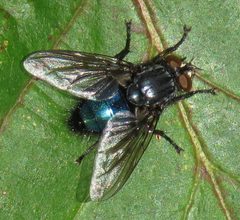
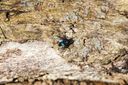
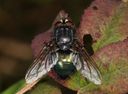
Cynomya is a of blow flies ( Calliphoridae) commonly known as 'dog-flies' from the Ancient Greek κυνόμυια. in this genus are large, conspicuous flies of forensic interest, primarily distributed across the Palaearctic Region with some overlap in Alaska and the Russian Far East. The genus includes species such as C. mortuorum and C. cadaverina, which are associated with carrion and occasionally recorded as agents of myiasis. Unlike many calliphorids, Cynomya species are not strongly and are rarely abundant in nature.
Pronunciation
How to pronounce Cynomya: //sɪˈnɒm.jə//
These audio files are automatically generated. While they are not always 100% accurate, they are a good starting point.
Identification
Large, robust blow flies with metallic coloration. Cynomya can be distinguished from other calliphorid by their relatively large size and specific wing venation patterns, though precise identification typically requires examination of genital structures. Males possess relatively large, strongly sclerotized genitalia. The genus is characterized by a weak attraction to UV light compared to other blow flies such as Lucilia sericata and Phormia regina.
Images
Habitat
Associated with animal burrows and small mammal carcasses. Found in outdoor environments with access to decomposing animal matter; not strongly tied to human habitations. Laboratory colonies maintained successfully at 15-21°C with 16:8 .
Distribution
Primarily Palaearctic Region. C. mortuorum recorded in Europe including Belgium, with distribution extending to Alaska and the Russian Far East where ranges overlap with C. cadaverina. North American records include Vermont and scattered locations in the eastern and central United States. The is rarely abundant anywhere in its range.
Diet
Necrophagous; larvae develop on carrion. require protein for ovarian development; in laboratory conditions, fed ad libitum on water, sugar, powdered milk, and beef .
Life Cycle
Complete with , larva, pupa, and stages. For C. mortuorum at 22°C: egg-to-adult development averages 18.05 days for females and 18.47 days for males. The pupal stage represents approximately 56.7% of total development and lasts about 10.3-10.4 days. Pupal weight decreases approximately 8.75% during the first 8 days of . Sexual size dimorphism present: female pupae average ~20% lighter than male pupae, with this difference persisting in adult dry weight.
Behavior
Calm disposition in laboratory conditions, less easily disturbed than Lucilia sericata. Weak attraction to UV light, distinguishing this from many other calliphorids that are strongly phototactic to blacklight traps. are active fliers and have been observed at blacklight sheets, though they are difficult to photograph due to rapid, erratic movement.
Ecological Role
Forensic used in estimating post-mortem intervals and potentially detecting cadaver relocation. Agent of myiasis in mammals, recorded from hares. Contributes to carrion decomposition and nutrient cycling, though rarely abundant enough to be ecologically in decomposition .
Human Relevance
Limited forensic utility due to rarity in casework; less commonly encountered than other calliphorids such as Lucilia or Calliphora . Not considered a significant pest or . Occasionally mistaken for the more common 'bluebottle' flies.
Similar Taxa
- LuciliaBoth are metallic blow flies in Calliphoridae, but Lucilia are generally smaller, more strongly attracted to UV light, and more easily disturbed in laboratory conditions.
- CalliphoraSimilar large size and metallic appearance, but Calliphora typically show stronger tendencies and different wing venation.
- PhormiaBoth contain blacklight-attracted blow flies, but Phormia show strong UV attraction unlike the weak attraction observed in Cynomya.
Sources and further reading
- BugGuide
- Wikipedia
- GBIF taxonomy match
- iNaturalist taxon
- NCBI Taxonomy
- Catalogue of Life
- Bug Eric: First Night of Blacklighting
- Bug Eric: April 2024
- Bug Eric: City Nature Challenge 2023 Recap
- Figure 1: The distribution of Cynomya mortuorum in Europe (source: http://www.gbif.org, 09/2016).
- Preliminary data on pupal development, lifespan and fertility of Cynomya mortuorum (L., 1761) in Belgium (Diptera: Calliphoridae)