
Cynomya cadaverina
Robineau-Desvoidy, 1830
Shiny Blue Bottle Fly
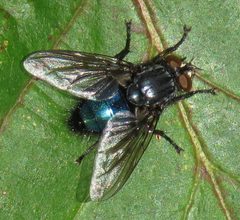
Cynomya cadaverina, commonly known as the shiny blue bottle fly, is a blow fly in the Calliphoridae. are medium-sized with distinctive metallic blue coloration and are attracted to carrion, particularly in advanced stages of decomposition. The is considered forensically significant for estimating post-mortem intervals, as its predictable and cool-weather activity patterns provide temporal clues in death investigations. It is native to the Nearctic region, with highest abundance in southern Canada and the northern United States.
Pronunciation
How to pronounce Cynomya cadaverina: //sɪˈnɒmiə ˌkædəˈvɛrɪnə//
These audio files are automatically generated. While they are not always 100% accurate, they are a good starting point.
Identification
Distinguished from other blow flies by the combination of shiny metallic blue (not green or coppery), dark blue to black with darker blue stripes, and white calypters. Larger than many common Lucilia . Cool-weather activity and association with advanced decomposition stages can aid field identification. Distinguished from Cynomya mortuorum by geographic range and subtle morphological differences; C. mortuorum is Palearctic.
Images
Appearance
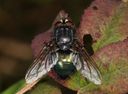
Medium-sized fly, 9–14 mm in length. shiny metallic blue, giving the its . dark blue to black with distinctive darker blue stripes on the dorsum behind the . White calypters. Bare stem . Parafacial ground color black to reddish-brown with yellow covering. present. Bristles on meron, a characteristic of Calliphoridae.
Habitat
Associated with carrion and decomposing organic matter. Colonizes carcasses in highest numbers during cool weather. may enter buildings during winter months. Described by FDA as a 'filthy fly' that breeds in excrement and thrives in unsanitary conditions.
Distribution
Nearctic region. Most abundant in southern Canada and northern United States. Recorded as far south as Florida and Texas. Not native to Europe; distinguished from the similar European Cynomya mortuorum by distribution.
Seasonality
Cool-weather with peak activity in spring and fall. Overwinters as . Adults may be active during winter and enter buildings. Attracted to blacklights in early spring (March–April).
Diet
Larvae feed on carrion and decomposing animal tissue. feed on fluids from decomposing matter and may visit filth and excrement.
Life Cycle
Holometabolous: , three larval instars, pupa, . Eggs laid in open wounds or natural body openings on carrion, in small clusters or singly. Eggs hatch in 24–72 hours. First instar approximately 20 hours, second instar 16 hours, third instar 72 hours. Larvae disperse to pupate; pupal stage approximately 9 days. Total 17–19 days at favorable temperatures. Up to 17 per year under optimal conditions, with 25–50 eggs per generation. Development strongly temperature-dependent; ceases at temperature extremes.
Behavior
Attracted to advanced stages of decomposition, rarely to fresh carrion. Typically arrives in second wave of , after Lucilia and Calliphora . Demonstrates clustering and . attracted to light. May enter buildings during winter.
Ecological Role
Decomposer; facilitates breakdown of carrion. Forensically significant as a for estimating time since death. Occasional participant in myiasis ( of living tissue by fly larvae), though not a regular agent.
Human Relevance
: used to estimate post-mortem intervals based on developmental stage and patterns. Subject of mitochondrial research to identify human remains from larval gut contents. Occasionally involved in accidental myiasis. Potential of and foodborne due to filth-breeding habits. Classified by FDA as a 'filthy fly'.
Similar Taxa
- Lucilia spp.Green bottle flies; distinguished by green or coppery metallic coloration rather than blue, and typically colonize fresh carrion earlier in .
- Calliphora spp.Blue bottle flies; often larger, with different thoracic coloration patterns, and typically earlier colonizers of carrion.
- Cynomya mortuorumEuropean counterpart with similar ; distinguished by Palearctic distribution versus Nearctic distribution of C. cadaverina.
More Details
Forensic Significance
C. cadaverina is specifically valuable in medicocriminal investigations because its attraction to advanced decomposition stages and predictable cool-weather provide independent temporal data. Its mitochondrial is under research for identifying human remains when bodies are too decomposed for conventional identification.
Temperature and Development
Development rate is strongly temperature-dependent; above or below threshold temperatures, all development stops. This thermal sensitivity must be accounted for in post-mortem interval calculations.