
Pelina
Haliday, 1837
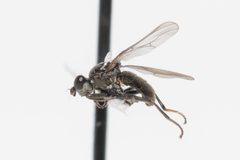
Pelina is a of shore flies ( Ephydridae) established by Haliday in 1837. It belongs to the order Diptera, which comprises the true flies. The genus is part of the diverse family Ephydridae, commonly known as shore flies or brine flies, which are typically associated with aquatic or semi-aquatic . Pelina are small flies, though specific morphological details for the genus as a whole remain poorly documented in accessible literature.
Pronunciation
How to pronounce Pelina: /pɛˈliːnə/
These audio files are automatically generated. While they are not always 100% accurate, they are a good starting point.
Identification
As a within Ephydridae, Pelina can be distinguished from other shore fly genera by genitalic characters and specific arrangements of bristles on the and , though precise diagnostic features require examination. The Ephydridae is characterized by small size (usually 1-6 mm), reduced wing venation with a distinct anal , and often a humped thorax. Generic-level identification within Ephydridae typically requires microscopic examination of male terminalia and chaetotaxy patterns.
Images
Distribution
Records indicate presence in Denmark (DK), Norway (NO), and Sweden (SE), suggesting a distribution centered in northern Europe. The may have a broader range, but confirmed records are limited to these Scandinavian and adjacent regions.
Similar Taxa
- Other Ephydridae generaMany shore fly share small size, reduced wing venation, and aquatic associations. Definitive separation of Pelina from related genera such as Ephydra, Scatella, or Paracymus requires examination of subtle morphological characters including facial bristle arrangement, wing patterns, and male genitalic structures.
More Details
Taxonomic Note
The Pelina was established by Alexander Henry Haliday in 1837. Haliday was a prominent Irish entomologist who made significant contributions to the of Diptera. The etymology of the genus name is not clearly documented in standard references.
Data Limitations
Information about this is sparse in publicly accessible databases. The 14 iNaturalist observations suggest it is rarely encountered or underreported. No -level treatments or comprehensive revisions of Pelina appear readily available in major taxonomic databases, and the genus lacks a Wikipedia entry distinct from an unrelated genus (Luma) that was incorrectly associated with this name in some sources.