
Parydra
Stenhammar, 1844
Species Guides
2- Parydra aquila
- Parydra quadrituberculata(shore fly)
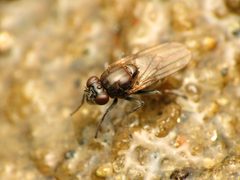
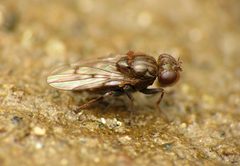
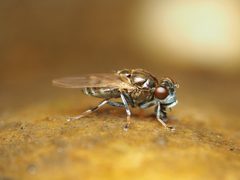
Parydra is a of shore flies (Diptera: Ephydridae) comprising at least 70 described . Species in this genus are associated with wet, muddy , particularly the vegetated margins of ponds, marshes, and slow-moving water bodies. Larval development occurs in saturated substrates where larvae feed on and decaying organic matter. are typically found near larval habitats and are most active during warmer months.
Pronunciation
How to pronounce Parydra: /pəˈrɪdrə/
These audio files are automatically generated. While they are not always 100% accurate, they are a good starting point.
Identification
Identification to level requires examination of male terminalia and detailed morphological characters; European species are distinguished using the key provided by Stuke (2022), which emphasizes features of the habitus and genital structures. The is characterized within Ephydridae by features associated with its shore-fly and , though specific diagnostic traits for the genus are not detailed in available sources.
Images
Habitat
Wet, muddy with emergent vegetation; shallow margins of ponds, marshes, and slow-moving water bodies with saturated mud and algal growth. Larvae develop in moist substrates with decaying organic material.
Distribution
Widespread across the Palearctic region with records from Europe (including Croatia, Cyprus, Finland, France, Georgia, Greece, Italy, Jordan, Morocco, Portugal including Madeira, Romania), north-west Russia, Siberia, and Crimea. Additional records from Kyrgyzstan and North America (based on P. quadrituberculata studies). GBIF distribution records include Colombia, Denmark, Norway, and Sweden.
Seasonality
are active during warmer months; P. quadrituberculata appears to have a single per year in temperate regions, suggesting spring to summer activity.
Diet
Larvae are phytophagous and detritivorous, feeding on and decaying organic matter in muddy substrates. feeding habits are not documented.
Life Cycle
, three larval instars, pupa, and . Oviposition occurs in moist muddy substrate of larval . takes place within the same muddy substrate without construction of a distinct case or tube. Voltinism appears to be in at least some temperate .
Behavior
Larvae do not construct distinct cases or tubes. occurs within the larval substrate. remain in proximity to larval and do not appear to disperse widely from sites.
Ecological Role
Decomposer and in wetland and shoreline ; contributes to nutrient cycling in muddy, vegetated through consumption and processing of and decaying organic matter.
Similar Taxa
- Other Ephydridae generaParydra can be distinguished from other shore fly by the combination of specificity (wet muddy margins with emergent vegetation), larval feeding ( and detritus), and morphological features of the male terminalia; precise differentiation requires taxonomic keys and examination of genitalic structures.
More Details
Taxonomic complexity
The includes a recently established subgenus Chaetoapnaea for four (P. flavitarsis, P. nubecula, P. quinquemaculata, P. undulata). Several synonymies have been proposed in recent revisions, and P. unicolor is treated as a .
Research limitations
Detailed biological information is available for only a few (notably P. quadrituberculata); most species remain poorly known with respect to stages, diet, and .