
Brachydeutera argentata
(Walker, 1853)
shore fly, shorefly
Brachydeutera argentata is a of shore fly in the Ephydridae, first described by Francis Walker in 1853. The species is known from the United States, where it inhabits moist shoreline environments. Shore flies in this family are typically small, compact dipterans associated with wet or aquatic . The specific epithet 'argentata' refers to a silvery appearance, likely describing some aspect of the coloration.
Pronunciation
How to pronounce Brachydeutera argentata: //ˌbræ.kɪˈdjuː.tə.rə ˌɑːr.dʒənˈtɑː.tə//
These audio files are automatically generated. While they are not always 100% accurate, they are a good starting point.
Identification
Distinguished from other shore flies by combination of: small size, silvery appearance (suggested by epithet), and association with shoreline . Separation from congeneric requires examination of genitalic characters and detailed morphological analysis not covered in general sources. The Brachydeutera is distinguished within Ephydridae by specific chaetotaxy and wing venation patterns.
Images
Appearance
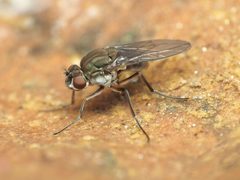
Small shore fly with compact body typical of Ephydridae. The specific epithet 'argentata' suggests silvery coloration, though detailed morphological descriptions are limited in available sources. Members of the Brachydeutera generally have reduced wing venation and short characteristic of shore flies.
Habitat
Moist shoreline environments, including mud and sand banks near water bodies. Observed on surface of mud puddles. Typical Ephydridae includes aquatic and semi-aquatic environments: lake shores, river banks, salt marshes, and other wetlands.
Distribution
United States (documented occurrence). The Brachydeutera has broader distribution in the Americas.
Seasonality
Activity period not specifically documented. shore flies in temperate regions typically active during warmer months when aquatic are available.
Behavior
Observed resting on surface of mud puddles. Typical shore fly includes on wet substrates and surface film of water bodies rather than flying extensively. often found in near suitable breeding sites.
Ecological Role
Member of shoreline insect ; likely contributes to nutrient cycling in aquatic-terrestrial interface zones. Ephydridae larvae typically function as decomposers or grazers in aquatic , though specific larval for this is undocumented.
Human Relevance
No documented economic or medical significance. Occasionally observed in citizen science contexts (e.g., City Nature Challenge). Not known as pest or beneficial .
Similar Taxa
- Other Brachydeutera speciesCongeneric share general and preferences; require genitalic examination for definitive separation
- Other Ephydridae generaShare shore fly and ; distinguished by wing venation, chaetotaxy, and genitalic characters
More Details
Taxonomic history
Originally described as Notiphila argentata by Walker in 1852/1853, later transferred to Brachydeutera. Authority sometimes cited as (Walker, 1852) or (Walker, 1853) in different sources.
Observation records
Documented in citizen science observations including City Nature Challenge 2023 in Kansas, where observed on mud puddle surface.
Sources and further reading
- BugGuide
- Wikipedia
- GBIF taxonomy match
- iNaturalist taxon
- NCBI Taxonomy
- Catalogue of Life
- Return to Guatuso, Costa Rica: Trouble for stingless bees - the silver orb weaver, 'Argiope argentata' — Bug of the Week
- Tiger beetles in Argentina’s Chaco forest | Beetles In The Bush
- Stalking tigers in Argentina | Beetles In The Bush
- Bug Eric: City Nature Challenge 2023 Recap
- Beetle Research Roundup | Beetles In The Bush
- A non-black background is better… often! | Beetles In The Bush