
Curtonotum prolixum
Lindsay, 2019
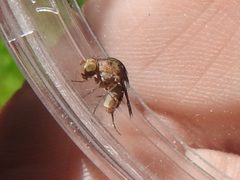
Curtonotum prolixum is a of fly in the Curtonotidae, described by Lindsay in 2019 from Central America and Mexico. It belongs to the Curtonotum murinum , a group of five newly described species from the region. The species was formally described with photographic images as part of a taxonomic revision.
Pronunciation
How to pronounce Curtonotum prolixum: /kɜːrtəˈnoʊtəm proʊˈlɪksəm/
These audio files are automatically generated. While they are not always 100% accurate, they are a good starting point.
Identification
Curtonotum prolixum can be distinguished from other members of the C. murinum using the identification key provided in Lindsay et al. (2019). Specific diagnostic characters for this are documented in the original description with accompanying photographic images.
Images
Distribution
Central America and Mexico. The precise range is indicated on the distribution map provided for the C. murinum in Lindsay et al. (2019).
Similar Taxa
- Curtonotum abrelatasBoth are newly described members of the C. murinum from Central America and Mexico, distinguished in the identification key of Lindsay et al. (2019).
- Curtonotum irksumBoth are newly described members of the C. murinum from Central America and Mexico, distinguished in the identification key of Lindsay et al. (2019).
- Curtonotum notatumBoth are newly described members of the C. murinum from Central America and Mexico, distinguished in the identification key of Lindsay et al. (2019).
- Curtonotum transitusBoth are newly described members of the C. murinum from Central America and Mexico, distinguished in the identification key of Lindsay et al. (2019).
More Details
Taxonomic context
Curtonotum prolixum was described as part of a revision of the Curtonotum murinum , which previously contained unrecognized cryptic diversity in Central America and Mexico. The revision elevated five distinct from this complex, all described as new to science in 2019.
Data limitations
As a recently described , ecological and biological data for C. prolixum remain unreported in the scientific literature. The original description provides morphological and distribution records but does not include information on , associations, or .