
Oedalea
Meigen, 1820
Species Guides
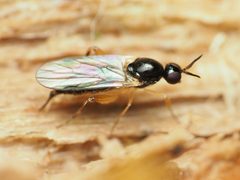
1Oedalea is a of in the Hybotidae, Oedaleinae. Members are characterized by robust bodies, conspicuously long , and hind legs adapted for capturing prey. The genus contains approximately 30 described distributed primarily across the Holarctic region, with records from Europe, Asia, and North America. are typically associated with vegetation, where they hunt small arthropods.
Pronunciation
How to pronounce Oedalea: //iːˈdeɪliə//
These audio files are automatically generated. While they are not always 100% accurate, they are a good starting point.
Identification
Distinguished from other hybotid by the combination of robust body form, unusually long , and hind legs with modified for grasping prey. The shiny black is a notable feature mentioned in taxonomic literature. -level identification requires examination of genitalic structures and other subtle morphological characters.
Images
Habitat
are found on leaves of trees and shrubs, typically in forested or wooded environments. Larvae develop in dead wood.
Distribution
Widespread across the Holarctic region. Documented from Europe (including Scandinavia: Denmark, Norway, Sweden), Asia (China, Japan, Vietnam, Russia), and North America (USA, Canada). First recorded from North Africa (Morocco) in 2022.
Diet
are , hunting small arthropods. Specific prey items have not been documented in detail.
Life Cycle
Larvae develop in dead wood; details of and larval feeding habits are not well documented.
Behavior
are active hunters on vegetation and can be collected in low numbers by sweeping leaves of trees and shrubs. They are not known to form .
Ecological Role
of small arthropods in forest and shrub layer . Larval development in dead wood contributes to wood decomposition processes.
Similar Taxa
- TrichinaAlso in Oedaleinae with similar body plan; distinguished by antennal and leg structure
- EuthyneuraAnother oedaleine with predatory habits; differs in thoracic and genitalic