
Rhamphomyia
Meigen, 1822
dance flies
Species Guides
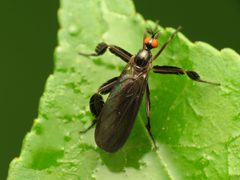
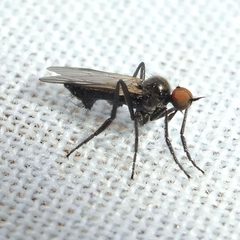
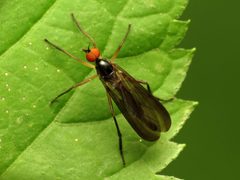
10Rhamphomyia is a large of dance flies (Empididae) comprising over 600 arranged in 8 subgenera. The genus exhibits remarkable diversity in mating systems, including sex-role reversal where females compete for mates and males provide . Several species display elaborate visual ornaments used in courtship, such as inflatable abdominal sacs and modified leg . The genus has a distribution with particular diversity in the Holarctic region, including specialized radiations in arctic tundra environments.
Pronunciation
How to pronounce Rhamphomyia: //ræmˈfoʊmiə//
These audio files are automatically generated. While they are not always 100% accurate, they are a good starting point.
Identification
identification within Rhamphomyia requires examination of male genitalia and subtle differences in wing venation, leg ornamentation, and body proportions. The can be distinguished from related empidid genera by the combination of: reduced or modified (); specific arrangements of bristles on the legs and ; and in males, often highly modified with enlarged upper . Subgeneric assignments rely on characters of the hypopygium and leg structure. Arctic species show reduced wing venation and eye modifications associated with ground-dwelling habits.
Images
Habitat
range from arctic tundra and subarctic environments to temperate forests, grasslands, and open woodlands. Specific microhabitats include: swarming sites typically associated with visual landmarks such as trees, fence posts, or topographic features; ground-level substrates for non-flying arctic ; and aerial zones near vegetation edges or over water. Some species occupy specialized such as treetop or grassy hayfields.
Distribution
Holarctic distribution with extensions into the Palaearctic (Europe, Asia Minor, Russian Far East, Middle Asia), Nearctic (North America), and Arctic regions (Canadian Arctic Archipelago, Greenland, Iceland). Specific records include: Denmark, Norway, Sweden, Vermont (USA), Turkey, Morocco, Armenia, Russian Far East (Magadanskaya and Amurskaya Provinces), Krasnoyarskiy Territory, Taymyr Peninsula, and Kyrgyzstan.
Diet
of most are predatory on small insects. Females of many species obtain food exclusively through transferred by males during mating and do not hunt independently. Prey items captured by males include small dipterans and other minute insects.
Life Cycle
Complete with , larval, pupal, and stages. Larval is poorly documented for most ; larvae of Empididae are generally predatory or scavenging in soil, decaying organic matter, or aquatic environments. Developmental timing varies with latitude, with arctic species showing abbreviated activity periods.
Behavior
Mating systems include both conventional and sex-role reversed forms. In sex-role reversed (e.g., R. longicauda, R. marginata), females form aerial swarms at dawn and dusk near visual landmarks, inflate their with air to appear more fecund, and display ornamented legs to attract males. Males select females based on these displays and provide —small captured insects—transferred during aerial mating. In conventional systems, males swarm and females visit to select mates. Some arctic species (e.g., R. ursinella) are virtually non-flying with ground-based hunting and mating. Swarming duration typically lasts 1-2 hours. Female swarming increases risk from spiders.
Ecological Role
of small insects as ; larvae likely contribute to soil dynamics. transfer represents a significant nutrient from males to females, potentially influencing female reproductive output. Sex-role reversed provide model systems for studying dynamics and the evolution of female ornaments. Arctic species represent adaptations to extreme environments including reduced capability and modified sensory structures.
Human Relevance
Subjects of extensive behavioral research on , sex-role reversal, and the evolution of mating systems. Some serve as indicators of quality in forest and grassland . The has been documented in citizen science projects including City Nature Challenge events. No known economic importance or pest status.
Similar Taxa
- EmpisRelated empidid with similar overall ; distinguished by different structure, male organization, and typically conventional (non-reversed) mating systems without female abdominal inflation displays.
- HilaraAnother empidid with ; distinguished by differences in leg bristle arrangement, wing venation, and typically different swarm markers.
Sources and further reading
- BugGuide
- Wikipedia
- GBIF taxonomy match
- iNaturalist taxon
- NCBI Taxonomy
- Catalogue of Life
- Nuptial Gifts and Other Romantic Gestures of the Bug World
- Bug Eric: City Nature Challenge 2024 Recap
- Bug Eric: What the Insects Have Taught Me
- Bug Eric: 2025 City Nature Challenge Recap for Kansas City Metro
- Bug Eric: May 2020
- The Mating Behavior of an Undescribed Species of Rhamphomyia (Diptera: Empididae)
- Rhamphomyia Meigen of the Canadian Arctic Archipelago, Greenland and Iceland (Diptera: Empididae)
- Biology of the Longtailed Dance Fly, Rhamphomyia longicauda (Diptera: Enipididae); a New Look at Swarming1
- New species and records of the Rhamphomyia subgenus Holoclera (Diptera, Empididae) from the Palaearctic Region
- Swarming Behavior, Sexual Dimorphism, and Female Reproductive Status in the Sex Role-Reversed Dance Fly Species Rhamphomyia marginata
- FEMALE MATING SWARMS INCREASE PREDATION RISK IN A 'ROLE-REVERSED' DANCE FLY (DIPTERA: EMPIDIDAE: RHAMPHOMYIA LONGICAUDA LOEW)
- New distributional data for the genera Empis Linnaeus and Rhamphomyia Meigen (Diptera: Empididae) in the Marmara Region with new records from Turkey
- THE FEEDING AND MATING BEHAVIOUR OF THE SPECIALIZED EMPIDINAE (DIPTERA); OBSERVATIONS ON FOUR SPECIES OFRHAMPHOMYIAIN THE HIGH ARCTIC AND A GENERAL DISCUSSION
- The Mating Behavior of Rhamphomyia pectinata (Empididae: Diptera) with Notes on Other Members of the Genus Found at the Same Locale in Northern Virginia
- New Species of Rhamphomyia Meigen (Diptera: Empididae) from the Palaearctic Region.