
Condylostylus longicornis
(Fabricius, 1775)
long-legged fly
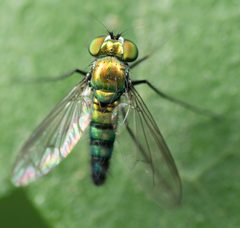
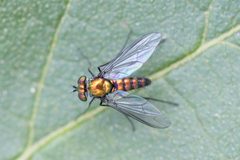
Condylostylus longicornis is a predatory long-legged fly in the Dolichopodidae, native to the Neotropics and southern United States. It has been introduced to multiple regions across the Pacific and Asia, including Hawaii, French Polynesia, Australia, and several South and Southeast Asian countries. The exhibits distinctive morphological traits including an iridescent green , elongated legs, and a characteristic resting posture with wings held diagonally. It functions as an active in agricultural and natural .
Pronunciation
How to pronounce Condylostylus longicornis: //ˌkɒndɪloʊˈstaɪləs lɒnˈɡɪkɔːrnɪs//
These audio files are automatically generated. While they are not always 100% accurate, they are a good starting point.
Identification
Distinguished from by combination of dark , brown fore tibia, and non-uniform bristle arrangement on mid- and fore-tibiae. Sexes separable by tibial coloration and bristle patterns: male with bristle row on mid tibia and basitarsus, female with uniformly yellow mid-tibia. Wing posture at rest (canted downward) differs from horizontally-held wings of many sympatric dipterans.
Images
Habitat
Prefers lightly shaded environments near water sources including swamps, streams, and meadows; also occupies woodland edges and agricultural fields. In Hawaii, collected from vegetation in urban park settings.
Distribution
Native range: Southern United States through tropical South America to Galápagos Islands. Introduced established in French Polynesia, Hawaii, Australia, China, India, Indonesia, Papua New Guinea, Philippines, Sri Lanka, and United Arab Emirates.
Diet
; consumes other insects. Specific prey items not documented in primary sources.
Behavior
Rests with narrow wings canted downward. Elaborate courtship documented for Dolichopodidae, though not specifically confirmed for this . Active in vegetation.
Ecological Role
of agricultural pests and including mosquitoes, bark beetles, and other insects. Considered potential agent of biological pest control and suggested as bioindicator for environmental quality monitoring, particularly for water quality assessment.
Human Relevance
Potential value in biological pest control programs; suggested as bioindicator for environmental monitoring. No documented negative impacts to humans.
Similar Taxa
- Other Condylostylus speciesShare -level traits including long legs, metallic coloration, and diagonal wing posture; distinguished by specific leg coloration and bristle patterns
- Other Dolichopodidae members share elongated legs and predatory habits; C. longicornis distinguished by combination of pattern, wing posture, and abdominal shape
More Details
Genomic resources
High-quality assembly available: 544 Mb nuclear genome with complete mitochondrial genome from Hawaiian specimen; first genome for tropical Dolichopodidae
Sex determination
XY sex determination system; male specimens used for sequencing due to heterogamety in
Sources and further reading
- BugGuide
- Wikipedia
- GBIF taxonomy match
- iNaturalist taxon
- NCBI Taxonomy
- Catalogue of Life
- Lab Study Shows Asian Longhorned Tick Can Spread Rocky Mountain Spotted Fever
- Be On the Lookout: There's a New Tick in Town
- Potential Range for Asian Longhorned Tick Covers Much of Eastern U.S.
- Invasive Tick Persists in New Jersey
- Invasive Tick Has Been Present in New York Longer Than Previously Known, Study Shows
- Different Tick, Same Repellents: CDC Study Shows How to Avoid Asian Longhorned Tick
- Ecological Insights into the Predatory Behaviour of Condylostylus longicornis in Agricultural Fields of Madurai District, India
- Whole genome sequence of a long-legged fly Condylostylus longicornis from Hawai'i.